
Trump's deterrence of international students is bad for business
Legal immigration for school and work purposes is good


The Trump Admin has expanded its crackdown on international students, revoking entry visas and terminating legal residency status without notice at several universities across the country. Some students have faced actions due to pro-Palestinian activism and traffic violations, but others for unclear reasons.
The environment being implemented by the Trump Admin will not attract the world’s talent from around the world. As the number of international students seeking to study and work in the U.S. increases, more of them are leaving for avoidable reasons.
Immigrants in the U.S. have significant involvement of U.S. patents, business start-ups, and scientific and medical research. It is pertinent that international students feel welcome and safe in the country. And though the opportunities they have for education and work are still widely available here, the Trump Admin’s recent economic moves are poking a hole in that optimism for future growth.
International students are important
Though representing just six percent of the higher education population, international students contributed more than $40 billion to the economy, creating and supporting over 350,000 jobs in 2023 alone. The economic benefits stemming from these international students are even more pronounced in the individual college towns where they live, study, and work.
For the most part, international students are choosing degrees in STEM and computer science, The work they typically seek after graduation is in industries with semiconductors, software infrastructure, and Fortune 500 companies.
Many international students attend universities in large metro cities like New York, Boston, and Los Angeles, but red and blue state economies alike benefit immensely from just a small percentage of international students: Arizona, Indiana, and Washington each earned nearly a billion dollars last year from their contributions.
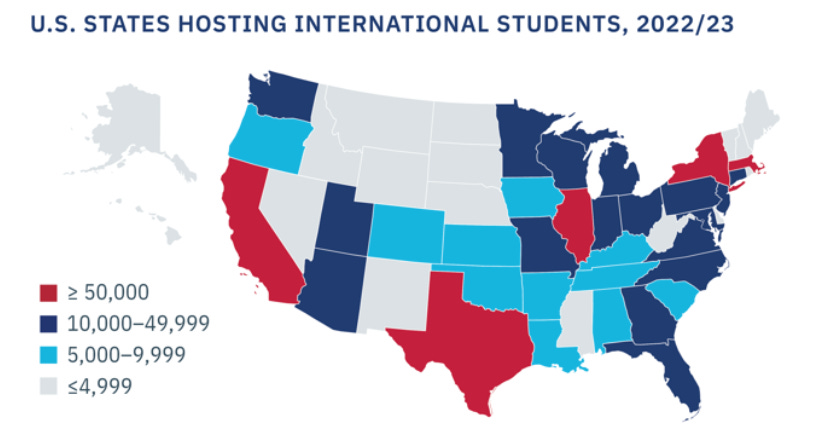
However, what was once a welcoming environment for international students in American universities is now clouded by uncertainty as the Trump Admin tightens immigration policies, enforces stricter visa regulations and carry’s out arbitrary deportations. The opportunity foreign students had to bring their knowledge and passions to the U.S. has become a high-stakes gamble. And with the president’s recent announcement of worldwide tariffs, the speculation of continued domestic economic growth has been stifled.
It won’t be long before international students start looking for more accessible opportunities elsewhere, presenting a big problem for an Admin purportedly set on bringing jobs and innovation here.
Trust the process?
Like native-born college students in the U.S., many international students are being introduced to independence for the very first time. They must make important, life-altering decisions about what they plan to do with their newfound freedom—especially when it comes to education and work. But unlike native-born students, international students must go through a rigorous process to obtain a visa in addition to the requirements for university applications and enrollment.
One thing that concerns me about a visa process that can take months and involves multiple forms, applications, certificates, transcripts, time, transportation, hundreds of dollars, and a bit of luck is that, at some point, it becomes a deterrent for the world's brightest and wealthiest young individuals. Despite having both the desire and resources to travel thousands of miles for educational and professional opportunities, international students must also prove an intent on leaving the U.S. once the timeline of study is completed or else face rejection.
Three-quarters of international students in STEM hope to stay in the U.S. after graduation, but that number is dropping quickly. Obtaining a degree doesn’t necessarily mean international student-graduates will have an opportunity to stay in the country to find work.
Additional hurdles like the Olympics
For the last decade, immigrants obtaining a green card have been evenly split between those already in the U.S. and those applying from their home countries. However, since 2021, that trend has shifted: now we are giving out more green cards to those abroad rather than those already in the country. This puts international students finding work after graduation at a further disadvantage when applying for extended legal status due to the dwindling rate at which they’re accepted over immigrants abroad.
The number of individuals admitted for Lawful Permanent Resident (LPR) status declined during the first Trump Admin and rebounded after COVID to similar levels. But now that the second Trump Admin is focusing on removing anyone who isn’t a citizen, international students have another burden placed on them.
With a declining number of international graduates ultimately staying in the United States, the problem of having fewer young, highly educated and skilled workers worsens. Our society is aging, birthrates are declining, and many of our own citizens are opting not to pursue degrees in STEM. The process for obtaining an employment-based immigrant visa is difficult and costly; students who want to stay in the US don't have a guaranteed pathway.

Trump’s immigration and economic vision conflict
Only international students with the best test scores, the most resources, and personal ambition get approved to attend universities inside the US. With the dwindling number of visas they hand out, and more of them wanting to leave the country after graduating, it should worry the Trump Admin’s goals of creating a prosperous economy with the most skilled and innovative people from around the world helping to pump it up.
In December, Trump named Sriram Krishnan, a tech entrepreneur who's worked at a bunch of social media and tech companies, as Senior White House Policy Advisor on AI. Shortly after the announcement, conservative activists started criticizing the pick of X, pointing out that Krishnan was born in India and that he made comments advocating for more green cards. Elon Musk and Vivek Ramaswamy responded to the backlash by arguing that hiring workers on H-1B visas is aligned with Trump's America First agenda. While I can’t agree with Ramaswamy’s tangent on X about how American culture has venerated mediocrity over excellence, I can say his argument comes from a place of desiring international students not just in the American workforce, but also in its cultural and intellectual discourse.
Trump has said before that visa programs were being abused to bring in foreign workers to replace American workers and suspended the H-1B program during the pandemic. Now he’s deporting international students for unknown reasons out of the blue. But I think there’s still hope he will notice the contradiction of wanting young, skilled workers from around the world pumping up the U.S. economy and also wanting to deport anyone not born on U.S. soil at random while destroying the industrial market with tariffs.
Last June, Trump reiterated the importance of international students on the nation's economy with a proposal to automatically grant foreign students green cards upon graduation. The president understands the significance of having more pathways for “competent” and “quality” people in the U.S. workforce.
Abuses of the system
Despite the policy changes by the Biden Admin in 2023, meant to make it easier for international students to come to the United States, application denials continued to climb from Consular and Embassy offices. The failure to prove “nonimmigrant intent” — that the applicant doesn’t intend to move permanently to the United States — is the reason that most nonimmigrant visas, including F-1s, are denied.
People sometimes manipulate the student-visa system to come to the United States to work, not study. According to the DHS Entry/Exit Overstay Report from 2023, around 2.5 percent of international students overstayed their visa. Several major countries, though increasing their number of prospective foreign students, like Canada and Australia, have moved to cap international student enrollments because of fraud concerns.
It’s good the abusers are found out before they enter, but it worries me that international students must go into the already-stringent process knowing if they show any intent on staying past graduation, they will likely be rejected. That should be the main reason we want international students to come to American universities! An over-cautious approach to this problem flies in the face of Trump’s correct points about the importance of maintaining a steady flow of high-skilled immigrants.
What can we do?
A proactive federal policy that expands dual intent, allowing international students to receive a student visa without having to prove they have no intention of working in the United States after graduation, would be a great first step. Creating a pathway to a green card for international student graduates of U.S. higher education institutions—similar to Trump’s proposal—would provide an immediate improvement. Raising the cap of green card visa’s from each country could also boost international student rates. Broadening access and making more efforts to market Optional Practical Training (OPT), an alternative to typical temporary visa cards, can help relieve some of the regression of interest.
I think it would be valuable for the U.S. to diversify the international student community choosing to study, research, and work here. This doesn’t mean setting a quotas, but rather broadening access to education in the U.S. by opening opportunities to more regions and countries worldwide, or increasing approval rates for those who face high rejection rates.
The problems associated with foreign individuals abusing the non-immigrant visa process in order to stay in the US is a better problem than not having enough international students who want to come here.
The Trump Admin’s latest economic policies, mostly surrounding protectionist trade policies with high tariffs, will hurt the most-sought job sectors hard. The deportations of international students without due process and against Court orders adds to the contemplation of those considering applying for student visas. The Admin’s cuts to research grants at medical organizations and universities will further dampen the appeal and incentive for them to come.
Our current approach of adding extra hurdles and creating an environment of fear for students across the world is not the best way to usher in the next generation of innovators and collaborators to humanities largest economic power.