
Thinking out loud about Venezuela
Drugs, oil, regime change--oh my!

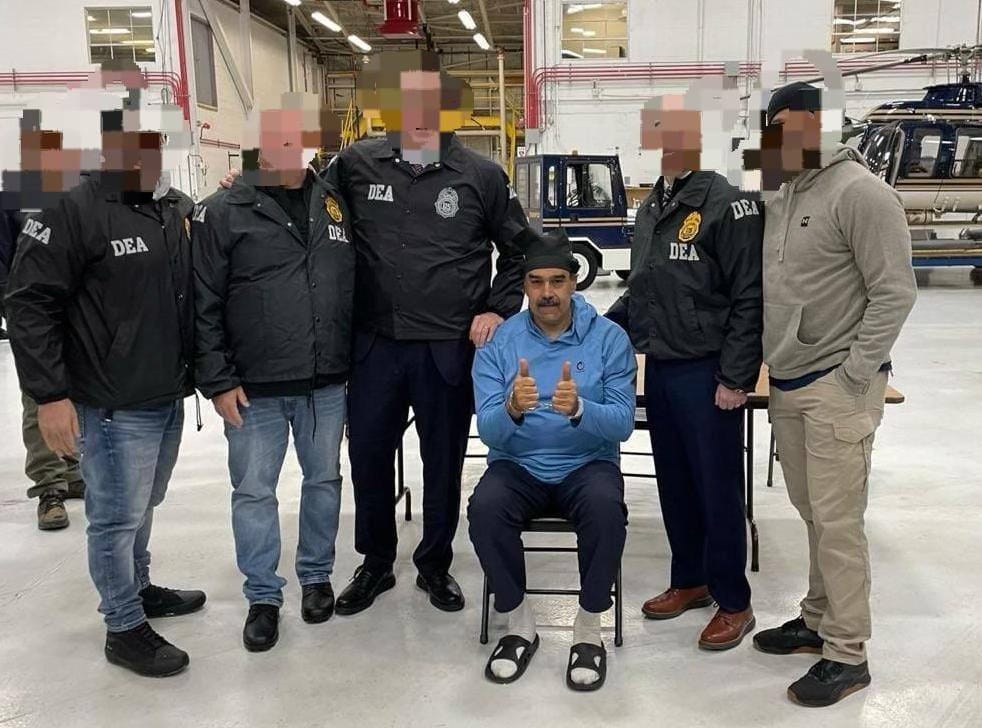
What has always fascinated me about specific military operations is the moment when overwhelming force collides not just with a foreign nation’s security apparatus, but also with the world’s expectations.
That’s why the American military operation reportedly carried out in Venezuela on January 3rd—“Operation Absolute Resolve”—has been stuck in my head. If the descriptions are accurate, it will likely go down in history as a huge technical achievement. Israel’s Operation Focus in 1967 comes to mind, when the majority of Egypt and Syria’s air forces were destroyed in a matter of hours. So does Ukraine’s clandestine “Operation Spiderweb,” in which drones concealed deep inside Russian territory crippled a significant portion of Russia’s long-range aviation fleet.
According to early accounts, more than 150 U.S. military aircraft were involved in strikes across northern Venezuela, culminating in the seizure of the country’s sitting president, Nicolás Maduro. It was swift. No U.S. troops were reportedly killed, though some were injured, and it remains unclear whether this operation marks a one-off intervention or the opening move of something longer and more entangling.
Still, there is a meaningful difference between being late and decisive, and being late and reckless. Arresting a foreign head of state in a contained operation is a tough endeavour. For that distinction alone, the military sophistication on display deserves acknowledgment and some praise.
Maduro has rights like everyone else
I’ve read the indictments. I’m not a lawyer or a legal scholar, so what follows is my best non-expert interpretation.
Count One: Narco-Terrorism Conspiracy
This charge requires prosecutors to prove two key elements beyond a reasonable doubt to a New York jury. First, that drug trafficking into the United States occurred. Second—and more difficult—that Maduro personally knew about it, and did so with the knowledge or intent that proceeds would support designated terrorist organizations.
If prosecutors fail to establish Maduro’s knowledge and intent regarding terrorist support, the statute collapses, even if drug trafficking itself is proven.
Count Two: Cocaine Importation Conspiracy
This count alleges that Maduro participated in the manufacture and distribution of cocaine abroad while knowing or having reason to believe that it would be smuggled into the United States, including U.S. territorial waters. The structure is more straightforward, but the burden remains the same: proof of knowing and intentional conduct.
A jury could find that trafficking occurred without finding that Maduro knowingly directed or approved it.
Counts Three and Four: Possession/Conspiracy of Machine guns and Destructive Devices
These are not lesser charges, but they generally function as enhancements or extensions of the first two. They rely on the existence of a qualifying drug-trafficking offense and allege the knowing use of heavy weaponry in furtherance of those crimes.
In theory, Maduro could be convicted on these counts without convictions on the first two, but doing so would be considerably more difficult.
All of this, of course, presumes that U.S. courts are found to have jurisdiction and that claims of head-of-state immunity fail—an argument that has been raised before in U.S. courts, with mixed historical success.
We shouldn’t overlook politics
Much of what elected officials do is politically calculated, and it would be naïve to treat this operation as an exception. From a purely political standpoint, the Trump Admin appears to have made a fairly shrewd move.
Opposition to the arresting of Maduro is easily framed as sympathy for authoritarianism or narco-terrorism, whether or not that framing is fair. I initially thought that characterization might be overstated until I saw AP reporting of demonstrators openly holding pro-Maduro signs outside a New York courthouse.

Much of the liberal media has emphasized the supposed unpopularity of intervention in Venezuela. I’m not convinced that’s accurate. Polling I’ve seen suggests something closer to uncertainty than rejection: roughly 40 percent approval, 35 percent disapproval, and a sizable remainder unsure. That hardly signals opposition, especially when compared to other Trump scandals and policies. What’s more likely is that most people are confused, relieved by how easily Maduro was captured, and skeptical about the long-term strategy.
The more interesting political maneuver, in my view, is cultural rather than electoral. American voters have spent decades growing disillusioned with interventionism. Trump needed a model that distinguished itself from the Bush-era formula of invasion, occupation, and nation-building. If this operation represents anything, it’s an attempt at a different template: initial dominance followed by leverage, rather than prolonged control followed by hope and prayers.
Whether that’s sustainable is another question.
Trump wants the oil. Rubio wants regime change.
I’m generally more open to intervention than many of my left-leaning peers. The United States has power, influence, and a set of values that I’d rather see shaping the world than those of Russia or China—or even Europeans. However, I don’t think we should plunge ourselves into needless conflicts.
It helps to have a working theory to judge actions on: like the search for WMD’s, the destruction of bin Laden and his helpers, or even stopping the spread of communism. Whether these turn out to be good theories is up for debate.
I’m just not sure the Trump Admin has any real coherent theory for what we’re doing in Venezuela. It seems to be a lot of overlapping interests: Trump wants the oil, Rubio wants regime change, and no one thinks Russia, China, or even Venezuela deserves to control or influence the nation. I think they’re using the drug-trafficking enforcement simply as a spring-board to begin the process.
Though Trump has stated multiple times the US will be running the government, Secretary of State Marco Rubio suggested the Admin would instead coerce cooperation from the new leadership through military operations on drug-trafficking and through control over the oil refineries.
I have my issues with this coercive strategy. First of all, we have little to no reason to think the backup for Maduro will be any more kind to US interests, nor that the people around him will cooperate. In fact, reports suggests corruption and oppression is widespread and a “team effort”. It was pointed out to Rubio that the regime remains in place, including the interior and defense ministers, who have ties to Russia and have been indicted by the U.S.
Rubio argues that the U.S. could only get one, which raises questions about the apparent success of the Admin’s goals. While there likely won’t be a “surge” like we saw in Afghanistan and Iraq (where opposition forces returned to the battlefield after we thought we had already won) it may be an even tougher mission here to remove all the adversarial figures in the first place, since the fight will take place in courts and public opinion rather than in combat.
It’s the oil, stupid!
Venezuela today produces a fraction of the oil it did 15 years ago. And roughly three-quarters of its reserves consist of extra-heavy crude, which requires specialized refineries and advanced extraction techniques. Many of Venezuela’s facilities have not been modernized to handle this. Meanwhile, the world’s largest heavy-crude refineries are located in Texas and Louisiana.
It’s not hard to imagine that Trump saw a closing window of opportunity—combined with security concerns about Russia and China—and decided to act. Whether the goal is to revive Venezuelan exports for U.S. allies or simply to exert control over the flow of oil, influence over energy remains the most plausible sticking point.
Final thoughts
We shouldn’t want the Admin to feel they have free rein to invade other countries or kidnap foreign leaders—but they should act if they truly believe there’s a compelling reason. Those reasons need to be precise and narrowly tied to the specific conflict or situation at hand; they shouldn’t automatically justify actions in Cuba, Colombia, or elsewhere.
I’m truly worried that’s the exact plan the Trump Admin has in mind: get people on board with Venezuela and they’ll have little argument against doing the same other places.
There’s a lot more questions than answers thus far and I fully agree with Joe James about not giving foreign policy takes in the midst of the event spilling out into our feeds. But I did want to put some thoughts out here for readers in a sort of thinking-out-loud formed article. It seemed to me that too many write about these things with the presumption that they’re an expert or have more information than the reader, but I am openly laying out the information I possess and how I’m thinking about the situation thus far. I will leave this with a great excerpt that exemplifies the humble and unpredictable perspective of viewing these things, especially when Trump is involved":
When it comes to predicting the president’s next move, too many politicians and analysts assume coherence where there is division, chaos when there is improvisation, and restraint where there is only selectivity. Trump’s foreign policy behavior emerges not from doctrine but from friction. Venezuela offered a target that felt weak, morally disreputable, geographically proximate, and manageable.
Under Trump, foreign policy outcomes are less the product of grand strategy than of episodic alignment. Observers should stop asking whether a given action is consistent with Trump’s supposed beliefs and start asking whether it is legible to him as fast, dominant, and containable. They should pay closer attention to intra-administration dynamics and to how ideas persist even when not immediately acted upon. Otherwise, the failure to predict Venezuela will not be an outlier.
Check out my other foreign policy articles:


"I’m truly worried that’s the exact plan the Trump Admin has in mind: get people on board with Venezuela and they’ll have little argument against doing the same other places."
Seems to be exactly the momentum they're hoping to gather for Greenland, if Miller is to be believed.