
The Smaller Big Lie: how the 2016 Democratic Primary divided the Left
Hating the game instead of the player is bad politics

.jpg)
The Big Lie
It would be hard for you to find someone who despises the actions and rhetoric of Donald Trump and his team leading up to and on January 6th, 2021, as much as I do.
I’m entirely prepared to die on the hill standing against Trump’s scheme to maintain his rule without voters’ consent, as violence transpired at the Capitol building for his own ambition, and while he waited until those ambitions were hopeless.
The infamous plot by Trump and his cronies is known by some as a peaceful day of patriotic sightseeing, to others as an insurrection—but commonly labeled the BIG LIE.
How such a “big lie” could still be fully believed by roughly 4 in 10 Americans, I cannot fully explain. Nonetheless, it was truly a horrific day.
And let me make myself extra clear early on here: Democrats, at least in my lifetime, have never done anything as horrifically undemocratic as January 6th.
But some on the Left think they have.
The Smaller Big Lie
For about a decade now, there’s been a similar, ‘Smaller Big Lie’ proliferating the minds of some on the left: a running conspiracy that arises anytime a discussion about the 2016—and even 2020—Democratic presidential primary occurs.
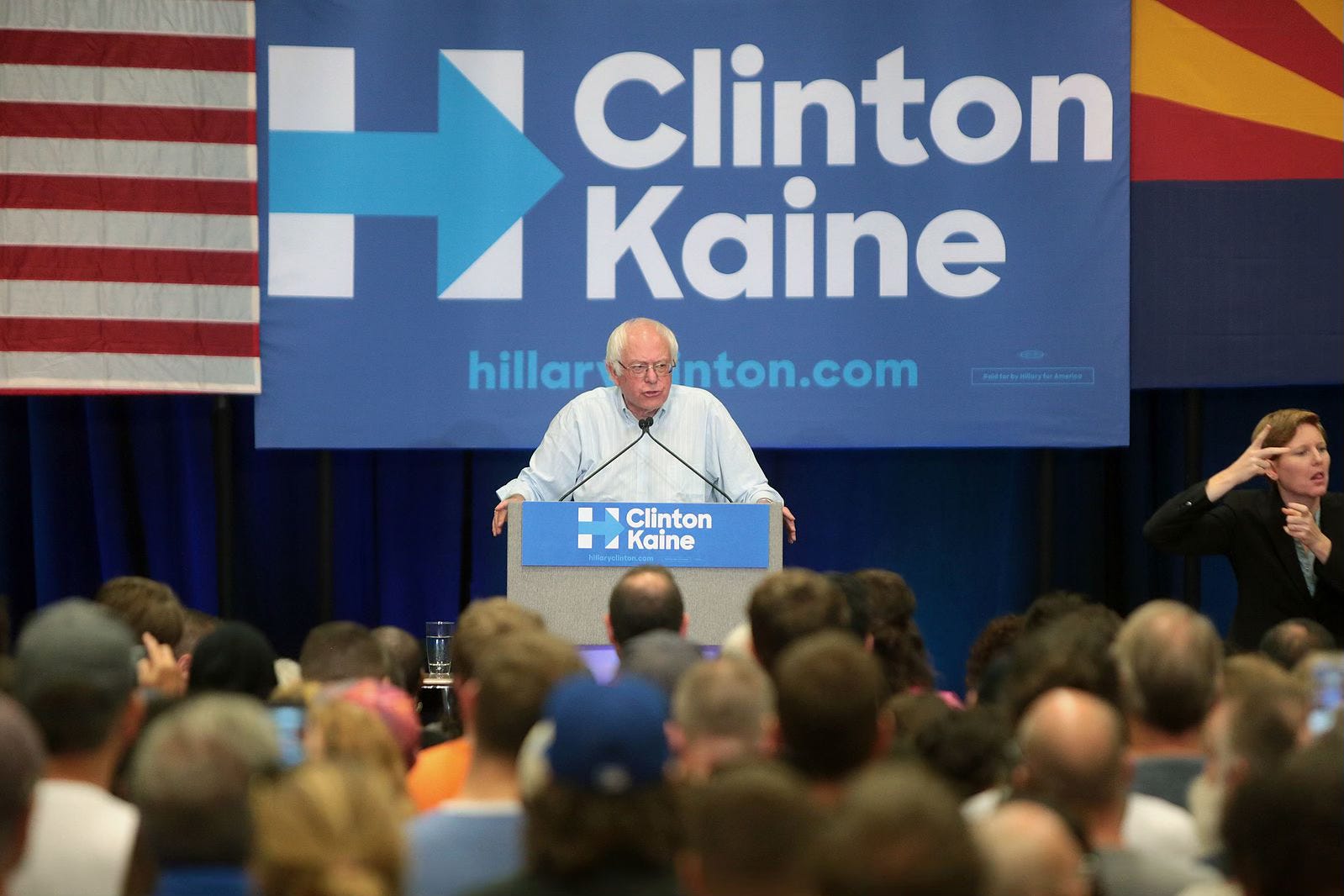
The Smaller Big Lie is a conspiracy from the anti-establishment Left claiming that Bernie Sanders was personally and corruptly shafted from the Democratic nomination for president in 2016 by the establishment elites who rallied around Hillary Clinton’s campaign.
Many in this group feel validated in this reasoning each time an establishment Democrat loses an election, like with the presidency in 2016 and 2024. In their view, Sanders—and any candidate to the left of him—would’ve won those general elections, or had a much better chance.
I happen to think this kind of cynical outlook on the American political system, where your only options are that your preferred candidate wins or the system is rigged against people like you, shows a complete ignorance of how electoral politics works.
What makes the Smaller Big Lie worse is, like the BIG LIE from Republicans, it uses the charge of malfeasance and marginalization by establishment elites to justify harmful actions on the political aspirations of those who claim to be on their side but don’t share their ideology to a tee: namely, the Democratic Party.
The 2016 Democratic Presidential Primary
Smaller Big Lie proponents view political institutions—and society generally—primarily through the lens of unbalanced power dynamics.
To them, the Democratic Party is just a conglomerate of establishment elites, which includes elected officials, funders, and interest groups, who use their wealth and position to maintain power. And they think moderate liberals, who make up a vast majority of the Democratic Party, were intentionally harming Sanders’ campaign by teaming up to endorse Hillary Clinton.
So, when the invisible primary occurred in 2016, and Clinton surged ahead of Sanders before many had a chance to vote, the progressive crowd criticized members of the Party for doing what progressives could never achieve: unity around a candidate with whom they had profound disagreements but had the best chance of beating Republicans.
Clinton was the candidate they preferred and one they had good reason to think could be victorious in the general election.
Nevertheless, the Smaller Big Lie proponents are right about one thing: these endorsements and funding of Clinton in the primaries really did shape the race in consequential ways. It’s just that the consequences were completely opposite of what they thought.
The establishment’s support of Clinton actually helped the populist, anti-establishment movement gain traction on the Left!
Vox, the progressive news media publication, explained it well at the time.
The irony is that Sanders was a prime beneficiary of this bias, not a victim of it…
Sanders didn’t need anything from the Democratic Party or from Hillary Clinton. He wanted his message heard, and the Democratic primary gave him a vehicle to make the world listen. And then he got a gift. Clinton, in reality, didn’t just clear the Democratic field for herself — she cleared it for Sanders also. If he’d been running in a race that included Warren and Biden and Booker, it might have been a lot harder for his voice to break through. He was the only candidate representing the party’s populist-liberal wing…
Sanders’s whole message was that the powerful and connected were rigging the systems of wealth and influence against the powerless, and here, in the Democratic Party, was one more example.
A Reuters survey in 2016 found that “half of Americans think the presidential nominating system was 'rigged'. The results also showed 27 percent of likely voters did not understand how the primary process works, and 44 percent did not understand why delegates were involved in the first place.”
The Smaller Big Liars took the saying, ‘Don't hate the player, hate the game’, to heart. And it’s been costing them influence in the political arena ever since.
Hillary Clinton was more popular than Bernie Sanders
In 2014, Hillary Clinton was the most popular potential presidential candidate in either party. She received a letter from every female Democratic senator, including Elizabeth Warren, urging her to run in 2016.
Clinton was America’s sweetheart. Bernie Sanders was still a nobody. He wasn’t even included in Gallup's favorability polling yet.
Nevertheless, many still look at all of Clinton’s endorsements, money, and political machinery and can’t help but feel pessimistic. That sense of sympathy with cynicism—about whether our political institutions can actually solve problems—bears an eerie resemblance to the mindset behind MAGA in the lead-up to, and on, January 6th.
As I’ve been explaining, there are often many other possible explanations for supposed corruption.
Sometimes, your ideology just isn’t as popular as you thought.
Where are the smaller big lies now?
The Smaller Big Lie is not as widely spread as an explicit theory as it used to; 2016 was a lifetime ago. But one way I know it’s still lurking in the left-wing shadows is that it persists in modified forms in each election cycle, especially when Democrats lose.
I think 2016 allowed for the Smaller Big Lie to proliferate because of the style of Clinton’s loss: winning the popular vote while losing all swing states. She ended up losing two of them, Wisconsin and Michigan, by less than 40,000 votes combined. Two states Sanders had won in the primaries.
In 2020, though, Sanders ran and lost in the primaries again. The Smaller Big Lie didn’t last for too long, likely due to the coalition calming after the Big Lie event on January 6th. Claims of corruption still appeared, especially when it came to Biden’s win in South Carolina, but were less toxic and shorter-lived (and violently outdone by Republicans).
In 2024, we heard similar Smaller Big Lie murmurings in the chaos that was Kamala Harris’ campaign. Particularly, these folks thought Democrats avoiding a primary a few months from the general election was unforgivably undemocratic.
The problems the Small Big Liars had with Hillary Clinton are similar to the ones they charged Kamala Harris, who was rated more liberal than even Sanders in 2020 before dropping out and joining the winning ticket. Harris picked up the mantle and ran a fairly moderate campaign in 2024—well, more moderate than many revolutionaries would’ve preferred.
Purity politics is a great way to lose support
The Smaller Big Lies are no longer truly about any single failed progressive campaign but rather in the flawed populist worldview of ‘Us vs. Them’. A bad electoral strategy at best and an intolerant culture of purity politics at worst.
Today, Sanders receives daily criticism from this group for not fulfilling his ideological purity. Other ideological members, such as those in the House Squad, are either out of office, have moderated and quieted, or are still hated by a wide portion of the electorate.
In New York City’s Mayoral primary, the self-proclaimed democratic socialist Zohran Mamdani won the nomination. For some reason, Smaller Big Lie enthusiasts got really excited about this, likely because he’s the best thing they’ve gotten from the rigged system since FDR. Ironically, ever since Mamdani’s victory, the Smaller Big Liars have been taking victory laps, demanding everyone in the Democratic coalition give their full and total endorsement of his campaign.
Despite Mamdani being possibly the most moderate and capitalistic socialist of all time, running against multiple other Democratic candidates, in one of the nation’s most progressive cities where less than a quarter of voters show up, they insist this is will show us where the wind blows.
This parallels a gubernatorial election in Virginia between a prominent establishment Democrat and a high-ranking state Republican in a state of over 3 million voters, which they’ve conspicuously refused to discuss.
The electoral outlook for the Senate and Presidency doesn’t look good for Democrats in 2028 or 2032 either. The electorate is more moderate than the Democratic Party, and certainly more conservative than the Smaller Big Lie coalition. That means Democrats need to become even more moderate. They need to understand how the primary system works, which issues are important, what positions are popular, and where they can make the most gains for the least cost.
The trending disadvantages for the left electorally in the U.S. political “game” is a reason for potential contenders like Gavin Newsom and Pete Buttigeig—and even AOC—moderating their stances half a decade prior to running.
Smaller Big Liars need to realize that if Democrats want to win a major national election against Republicans in upcoming elections, they ought to throw their theory about the American political system in the garbage, stop whining about the game, and start picking better players.
I had my ear chewed off at a ballgame by a white dude my age about how people dropping out and endorsing Biden and then James Clyburn endorsing him was somehow crooked because it “got black South Carolinians to vote for Biden!”. I asked him why he thought he knew what was best for those “black South Carolinians” better than they did or their actual black rep in congress. “No im
Not saying that I’m not saying that!”
I was like oh ok. Ur not saying THAT you’re just saying that when black people listen to a prominent black person who represents their community INSTEAD OF listening to white guys like you and their fave, Bernie, that it’s somehow corrupt?
I was interested to read this piece because I’ve recently heard the Bernie was cheated by insiders and more importantly, this view colored their viewpoints of the Democratic Party such that they thought Trump might be better for poor and working people. They couldn’t remember for instance that ever Democratic voted against Trump’s 2017 cuts for the rich. They couldn’t remember that Republicans blocked raising the minimum wage and that almost all Democrats were for it.
I would though have written this so that someone who was sympathetic to the idea that Bernie was cheated would be convinced that he wasn’t. I don’t think you addressed the most reasonable reasons why Sanders supporters feel cheated. Like the DNC really did give up some control to the Clinton campaign. And quoting an Ezra Klein article over a year the primary isn’t really in good faith.
In my mind it’s important to bring these folks back in. Some of them vote for Trump. Some of them give cover to their friends and acquaintances to for Trump. In some ways they might be the easiest Trump voters to get. But that means picking facts, details, and sources that they would find compelling and trustworthy.