
The serious case for taking Trump literally
Not taking Trump literally is going to go seriously wrong.

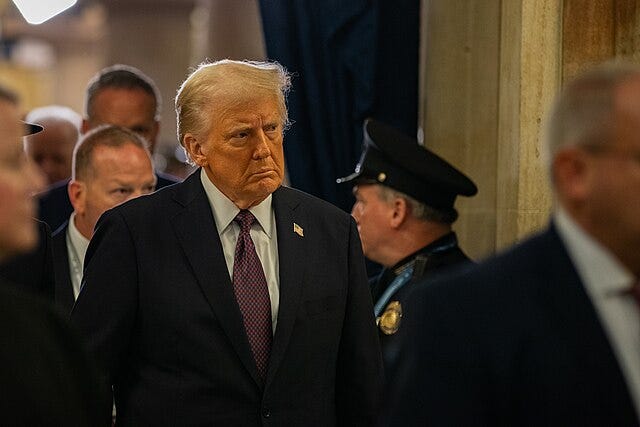

President Trump's threats to allies and walk-backs of campaign promises can be tiresome for those serious about political affairs and accountability. Finding yourself upset by his latest scandalous or defamatory moment is understandable, especially if you’re a Democrat who failed to persuade voters that he was too dangerous and incompetent to be reelected.
But I’m already noticing too many people —not in MAGA— start to turn incredulous when confronting Trump's coercive tactics. While I think Democrats should learn from their past mistakes, like exaggerating their opponents' procedural acumen and solidarity, since the election some have misinterpreted this lesson as: do not take Trump literally— ever.
Take threats from powerful people literally
Trump talks a lot of big game: it’s one of his supporters’ favorite things about him. He’s not afraid to publicly plot his revenge on people he feels wronged him in the past—for instance. One of the things we all know about Trump is that sometimes he does follow through on his threats, even in haphazard ways.
It would be difficult to convince Mark Zuckerberg he shouldn’t be taking Trump literally when he threatened to put him in prison and punish Facebook using powers as president. Anyone in Zuckerberg’s position would be foolish not to take the incoming president seriously and literally. These things are not mutually exclusive.
Taking Trump just seriously would mean Zuckerberg understood the significance of what Trump was saying: he had been treated unfairly by Meta (arguably true), and because of that, he was going to go after him using his power and influence as president, making Zuckerberg’s life and business a living hell (arguably authoritarian). But like I said, Trump will follow through some of the time.
When the one speaking has the power to literally deliver, the yes-men and supporters around him literally obey his commands, and literal immunity from criminal prosecution, the wise choice is to take them at their word—more times than not.
Trump was questioned a few days ago about if his threats to Zuckerberg helped spur Facebook’s overturn of a fact-checking policy, and he responded, 'Probably’. He’s right! Zuckerberg took his threats seriously and literally, and that’s how Trump meant it!
Someone will take him literally
One thing that gets lost when discussing whether people should take Trump seriously, literally, or a mixture of the two is that his most loyal supporters at least sometimes, some would argue the worst times, take him literally.
Trump told his supporters to come to D.C. for a giant protest on January 6th, and they literally showed up. He told them to march to the Capitol, and they literally broke the perimeter to reach the building. Trump said they couldn’t take back their country with weakness, and if they weren't strong they wouldn’t have a country anymore--they believed him. So, his supporters broke into the Capitol and searched for Vice President Mike Pence and Democrats in Congress to delay or absolve the count. And when Trump finally told his supporters to go home, they literally walked out of the building.
The fact that everyone else was only taking Trump seriously (meaning he felt he had been cheated and wanted a large rally of support as they certified the election) was irrelevant to the fact that thousands of people took him literally too— causing serious problems for everyone.
Democrats should know better
Why would Democrats not take a sitting president— the most powerful person on the planet—seriously and literally?
When Democrats only took President Biden seriously, they were unprepared for a range of possible effects stemming from his words.
Biden said he would appoint a Black female VP and Supreme Court Justice while running in 2020. Some took that as simply meaning Biden wanted to diversify positions in government; he meant it as a literal promise. The ones who took Biden literally from the start were more prepared for when it came to fruition.
Biden also said he was going to be a bridge between generations of Democratic leadership; most took him seriously but not literally. If we had taken him literally, I think more Democrats would have demanded he step aside once the 2024 campaign began. Biden has heard criticism from both sides of the aisle—and we should criticize him for it. But there is plenty of criticism to go around, even for those like me who brushed it off.
Taking your Commander in Chief literally is not a case of TDS or deep-state indoctrination. Trump, for some reason, just gets a pass— even from some Democrats; graded on a curve of literalness.
The next four years
Taking Trump literally should be a strategic mindset, not a foolproof guide on interpreting Trumpism. Trump will say lots of things.
We shouldn’t get ourselves in a hissy every time we see Trump's latest mischief: take his words with a grain of salt, but the critical assessment of his ideas should itself be serious and literal. We should be skeptical, yet fully prepared to attack his bad ideas.
When the president says he cannot rule out utilizing military and economic force to annex allied territory, or promises tariffs on all imports and prompting his DOJ on political opponents, taking him literally may come in handy when its time to hold him accountable.
When people tell you not to take Trump literally, what I think they mean is to not take your wildest interpretations of his claims literally. Trump likely will not be invading Ottawa or picking up and throwing Hispanic-American children over the border wall: but there is a lot of breathing room between those extremes and beefing with an ally over trade policies or deporting American children of illegal immigrants.
Only taking Trump seriously opens the possibility for MAGA to start thinking literally, too. By publicly criticizing Trump for threatening allies, we don’t help the prospects of it coming true; by shrugging it off as just another Trumpism, you risk real, literal consequences.
The unpredictable (yet realistic) nature of his power and influence is enough to be concerned about the problems springing from taking him only seriously.
Trump changes his mind on a whim and doesn’t understand the structures and internal procedures of our government. However, Trump has been president before: he presumably understands the government and his abilities better than in 2016 or 2020. That’s also a real concern.
And with his entire campaign centered on vengeance and retaliation against those he feels wronged him, and no signs of walking back, it’s a good sign you should consider the serious consequences of never taking him literally.