
The paradox of free speech: how incitement leads to silence
Charlie Kirk, culture, and chaos

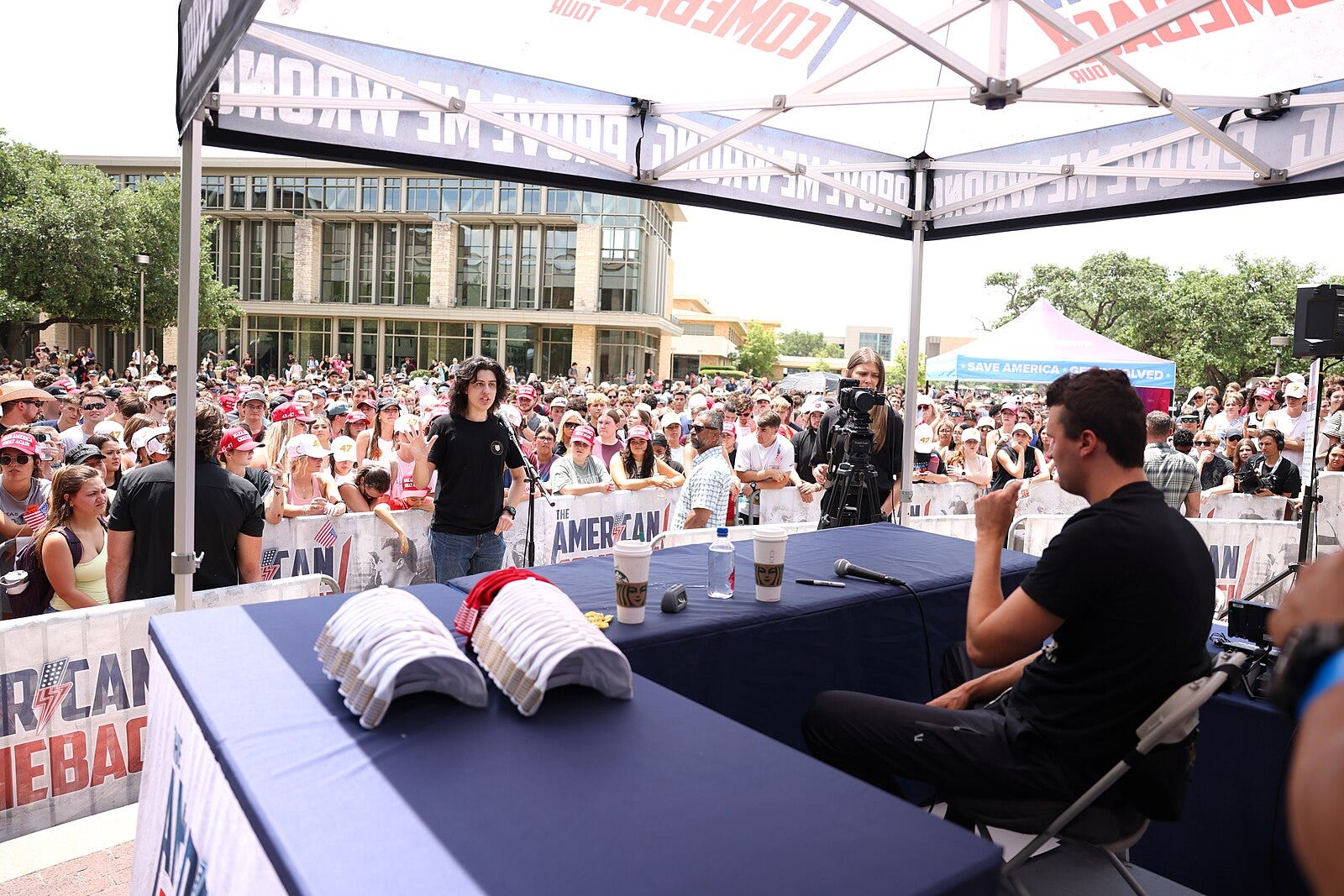
Ever since I got into politics in 2018, Charlie Kirk has been a consistent feature in my digital life. He pissed people off with his political takes, but he also earned the respect of many. His influence was earned by the fact that he engaged with almost everyone, confronting people’s criticisms of his worldview by embracing the value of free speech.
I genuinely respect that.
Sadly, though, in the wake of the fatal shooting of Kirk, many in our society seem more focused on which political tribe’s speech was responsible for his death than on how we can improve our understanding of which speech should be tolerated in the first place.
Kirk understood that the importance of free speech lies not just in accepting, but actively welcoming the right of others to voice ideas he found wrong and even dangerous. But some ideas aren’t just dangerous; they’re intolerant.
Rather than point fingers, we should truly contemplate this question: how do we protect free speech without being overwhelmed by ideas that, through violence, ultimately reject the very environment that makes open discourse possible?
The legal answer is that some speech is not protected under the First Amendment. One of the main legal standards of determining permissible speech is incitement to violence.1
The problem that’s appearing before us once more is that we have little cultural understanding of how to judge speech. We simply accuse each other of inciting violence without ever seriously grappling with what kind of speech we’re even talking about. Republicans say Democrats’ speech is uncivil and leads to violence; Democrats utilize the same charge.
As a result, we’re left with a widespread favorability towards almost all speech being protected, and yet persistent uncertainty about its limits—a paradox of tolerance towards speech.
The ambiguity of an objective standard
Over a century ago, in Schenck v. United States (1919), the Supreme Court ruled that speech could be limited if it created a “clear and present danger of a substantive evil” that Congress had the power to prevent.
The early cases on incitement to violence tended to focus more on the consequences—whether it led to a breach of peace, criminal action, or substantial interests of the state (like national security during wartime)2.
But what counts as a “substantive evil” was still vague, and courts struggled to consistently apply the standard. The important thing to remember here is that a ‘clear and present danger’ isn’t alone enough to be prosecutable; the speech in question must be intended or likely to initiate or further some other crime, like conspiracy or solicitation3.
Nearly half a century later, in Terminiello v. Chicago (1949), a popular meeting took place, headed by a Catholic priest who addressed a large audience in an auditorium outside of which was an angry, rambunctious crowd protesting against the gathering. The priest vigorously criticized various political and racial groups as failed efforts from police to maintain order persisted in vain. An uncontrollable riot broke out. His conviction for breaching the peace by inciting a riot was overturned.
The Court opinion expanded upon the Schenck ruling by arguing that speech could be restricted only in the event that the ‘clear and present danger of serious substantive evil’ rose far above public inconvenience, annoyance, or unrest. The Court tried to clarify the standard by introducing a formula: “the gravity of the evil, discounted by its improbability”4.
This was still pretty confusing, but it added a probabilistic element to the doctrine.
In Brandenburg v. Ohio (1969), the Court improved the incitement standard. Brandenburg, a KKK leader, gave a speech advocating for “vengeance” against Jews and Black Americans if the government didn’t stop advancing civil rights.
The Court ruled that speech is only unprotected if it is (1) directed to inciting or producing imminent lawless action, and (2) likely to incite or produce such action.
But it’s not as simple as checking two boxes: for speech to meet the intent requirement, the speaker must purposefully aim to trigger illegal action. Courts look for clarity of intention. It’s also not enough that lawless action could happen—the speech must make it probable, and the danger must be immediate, not distant or hypothetical. Courts weigh things like the crowd’s volatility, the timing, the speaker’s influence, and whether the action would have happened without the speech.
This is the legal standard we use for free speech today. And I’d like to think it’s where most people have a more intuitive sense of incitement: it's not just about the words themselves, but their intended and likely consequences.
The paradox of speech
Advocates of a specific partisan ilk often choose where and when to say things very deliberately—because they want their speech to have an effect. Like Kirk and many other political influencers, writers, and the rest, the point of their heterodoxy and sensationalism is to create some kind of fervor among the public.
That doesn’t mean we should judge speech purely by its consequences. But depending on the speech’s context, the same exact words can provoke entirely different cultural and legal questions.
For example, chanting “From the river to the sea” in a private home is not a legal concern. But chanted in a politically charged environment, like outside a Jewish synagogue, its intent and implications shift—and so should how we judge it culturally.
Again, that doesn’t mean such speech always—or ever—meets the legal standard of incitement. But it does mean intent, context, and consequences matter—and too often, we only start parsing them after violence occurs.
This is where the paradox of tolerance complicates things.
If we tolerate intolerant speech—such as speech that incites violence against tolerant speakers—at what point does principled openness turn into an accommodation of dangerous views? Legally, the standard requires both clear intent and a high likelihood of imminent harm. But culturally, those judgments are rarely objective. As a result, we constantly fall back on partisan allegiances, defending or condemning speech based more on its source than its substance.
Exceptions Complications to the rule
Even with the Brandenburg test in place, courts have continued to stare in the headlines of incitement rather than offering much insight for laymen.
Take NAACP v. Claiborne Hardware Co. (1982), where a civil rights leader gave a speech threatening Black residents who shopped at white-owned businesses. Organizers stood outside the stores, identified individuals who ignored the boycott, and publicly named them in local newspapers or aloud at NAACP meetings. In at least ten documented cases, those who violated the boycott were later subjected to acts of violence.
Nevertheless, the Court ruled that while the speech was intimidating, the link to actual violence wasn’t direct enough to lose First Amendment protection—nor did the Court concern itself much with the incitement aspect of the case5.
Take an ostensibly more direct case, Stewart v. McCoy (2002), where a man was charged with teaching gang members how to use violence to further criminal goals. Despite the clear connection to illegal activity, the Court upheld his free speech rights—because the speech was “teaching,” not advocating.
Intent, function, and style of speech, especially to criminal ends, are necessary to qualify as incitement. But so is the proximity to criminal action of the speech, how immediate or direct the accuser can connect such actions to the speaker’s original intent, with a certain (not totally clear) level of probability6.
The poisoned cultural standard for incitement
The real danger here is the cultural willingness to push the bar ever higher for what speech is protected, while simultaneously distorting real incitement standards when it suits us politically.
The social standard is too easily weaponized but not sophisticated enough to convince anyone on the other side. Depending on the political mood, incitement can either be ignored entirely or stretched beyond recognition. And this is exactly what’s happening in the aftermath of Charlie Kirk’s death.
As a society, we urgently need to improve our understanding of what counts as intolerant speech so that our standards aren’t discarded whenever someone we support crosses the line.
The cultural grasp of incitement may not perfectly match the legal one—but it’s not completely unrelated either. Without some serious reflection on that standard, we reduce it to a reactive accusation that only exists after it’s too late to matter for the person or ideology we’re advocating.
The paradox of tolerance warns us: if an open society continues to tolerate intolerant speech unchecked, it will inevitably silence the very openness it depends on, allowing only the voices of the intolerant to prevail.
I will do my part to not let that happen by being intolerant to intolerant viewpoints and embracing tolerant confrontation7. For the sake of our open society, I hope you do too.
One point worth establishing clearly is that incitement is not typically a standalone criminal charge. It’s a constitutional standard: a test used to determine whether speech falls outside First Amendment protection. If the speech isn’t protected, it can be prosecuted under other charges, such as solicitation, conspiracy, or true threats. This legal distinction between the charge of incitement and the standard for which speech is protected is one of the most commonly misunderstood aspects of American free speech jurisprudence.
A Socialist couple, the Schenck’s, distributed leaflets criticizing the military draft and urging men to disobey it—through peaceful action. Presumably due to the stigma’s of socialist ideology as well as the significance of war-time efforts during World War 1, the Court ruled the prosecution of the Schenck’s speech as constitutional.
As stated in 1, incitement is a standard by which speech is measured against. And typically, incitement is an initiation or furtherance of some criminal action, like solicitation—which is commonly conflated with the incitement standard. Additionally: some speech is not protected under the First Amendment but also aren’t determined by the incitement standard: this includes things like fighting words, libel, and obscenities.
Dennis v. United States (1951
The Court focused on whether the leader, Evers, could be held civilly liable for the economic losses suffered by the white store owners. Importantly, while the actions of Evers included public intimidation and naming violators, the connection between his speech and the subsequent violence was less direct, making it harder to definitively establish causality under the incitement standard.
I have some epistemic concerns about applying a standard of probability without clearly defining it through a non-probabilistic universal principle.
You all should be quite proud of me for writing an entire article on incitement to violence and not mentioning January 6th once. Oops. Okay, twice!
Interesting piece.
I think the most important conversation about limits of free speech is not about incitement. It’s about social media platforms and social media use. As more and more evidence piles up that social media use is unhealthy, and particularly social media monetized by algorithms designed to generate anger is harmful and was known to be harmful, we will, as a society have to decide how we should restrict social media. This will bump up against the free speech of social media companies and/or users.
Well written, Jordan. Interesting about speech that is not protected. I didn’t remember that.
I’ve been really upset by this. Another senseless act of violence. And it boils down to this: no one’s words MAKE anyone else do anything. People might not like what others say, they might get mad. But they choose what they do with that. They choose their actions, and they need to be held accountable. Someone CHOSE to shoot and kill Kirk. Because they didn’t like the words he says?? What he stands for?? It doesn’t matter if people don’t like what he says, it does not give anyone the right to kill him. It’s just heart breaking.
It all stems from the fact that we live in a broken world. And there is only One answer for that.