
The illusion of defeat: why Democrats can’t abandon trans rights


My most left-leaning position in politics is very possibly transgender issues. But I also sympathize with some of conservatives’ disdain for the pro-trans movement, particularly due to the arrogant intolerance coming out of certain leftist spaces on college campuses and on social media.
We’ve watched as Democrats catered to a crowd concerned only with identity politics, critical theory, and dogmatic disruption. At the same time, Republicans plotted an electoral strategy aimed at winning over voters who felt disdain towards that crowd. But they had to be careful not to overstep their own pitfalls on the trans issue. To accomplish this, they focused on just a few flashpoints: men in women’s bathrooms, trans athletes in women’s sports, gender ideology in schools, and gender-affirming care for minors.
The commonality was that these were narrow areas where public opinion was the most unstable and where Democrats were epistemically vulnerable. The infamous campaign ad line against Kamala Harris captured the strategy well: “[Democrats] are for they/them; [Republicans] are for YOU!”.
It is the success of this anti-trans framing by Republicans that has imprinted in many people the idea that the fight to protect trans rights is increasingly futile. But the reality is that transgender issues are one of the most advantageous topics for Democrats in existence.
Moderate Democrats are the trans community’s best friend
The Argument’s recent polling of transgender issues corroborates the intuitive success of the Republican scheme to make trans activism a dubious task. Almost anyone who reads it leaves with the impression that Democrats are on the wrong side of trans issues altogether.
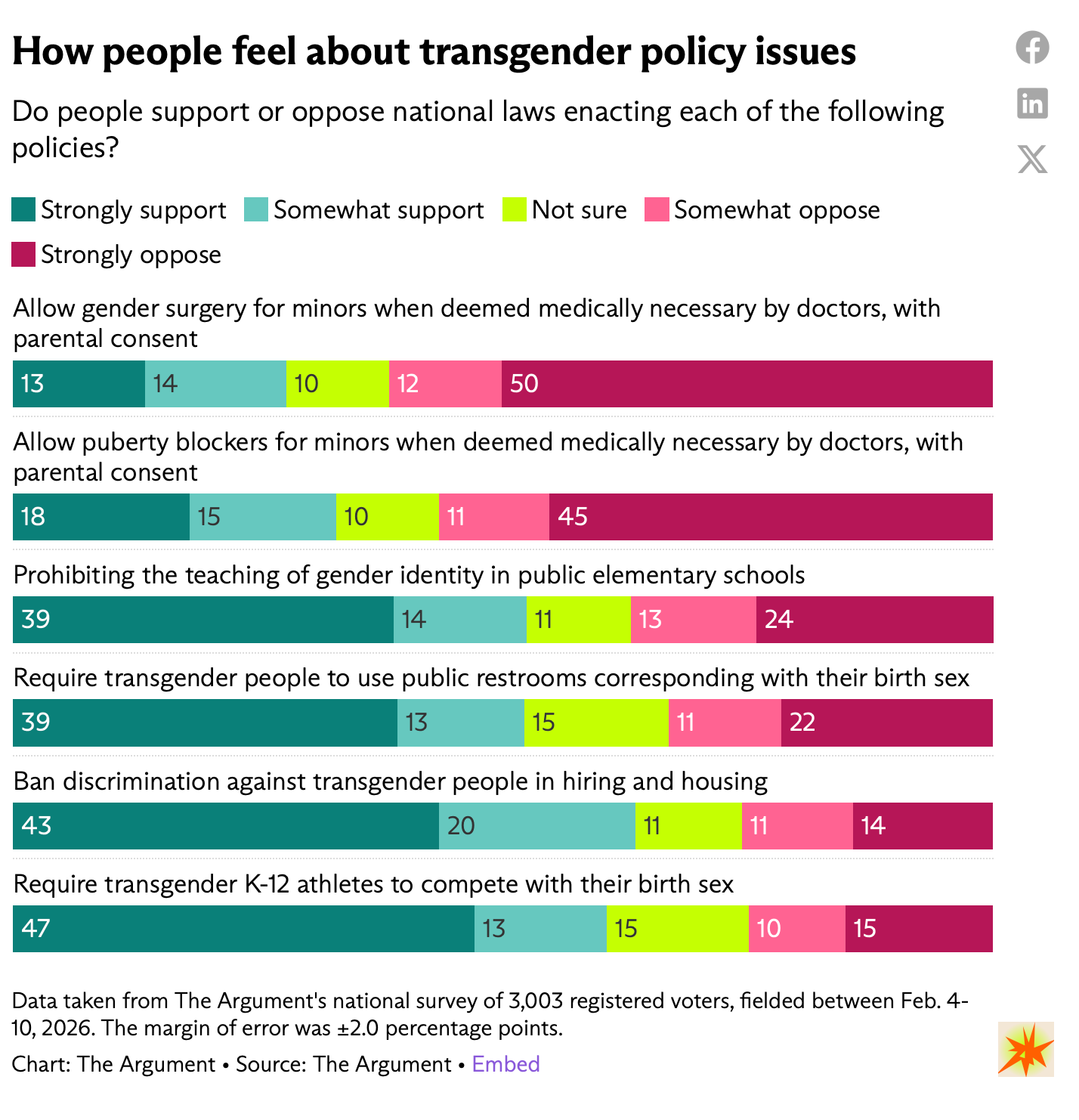
However, a couple of weeks ago I came across G. Elliot Morris’ polling on a range of key issues and which party was more trusted on each. To my immense astonishment, trans issues sat neatly on the Democrats side by similar margins as healthcare.
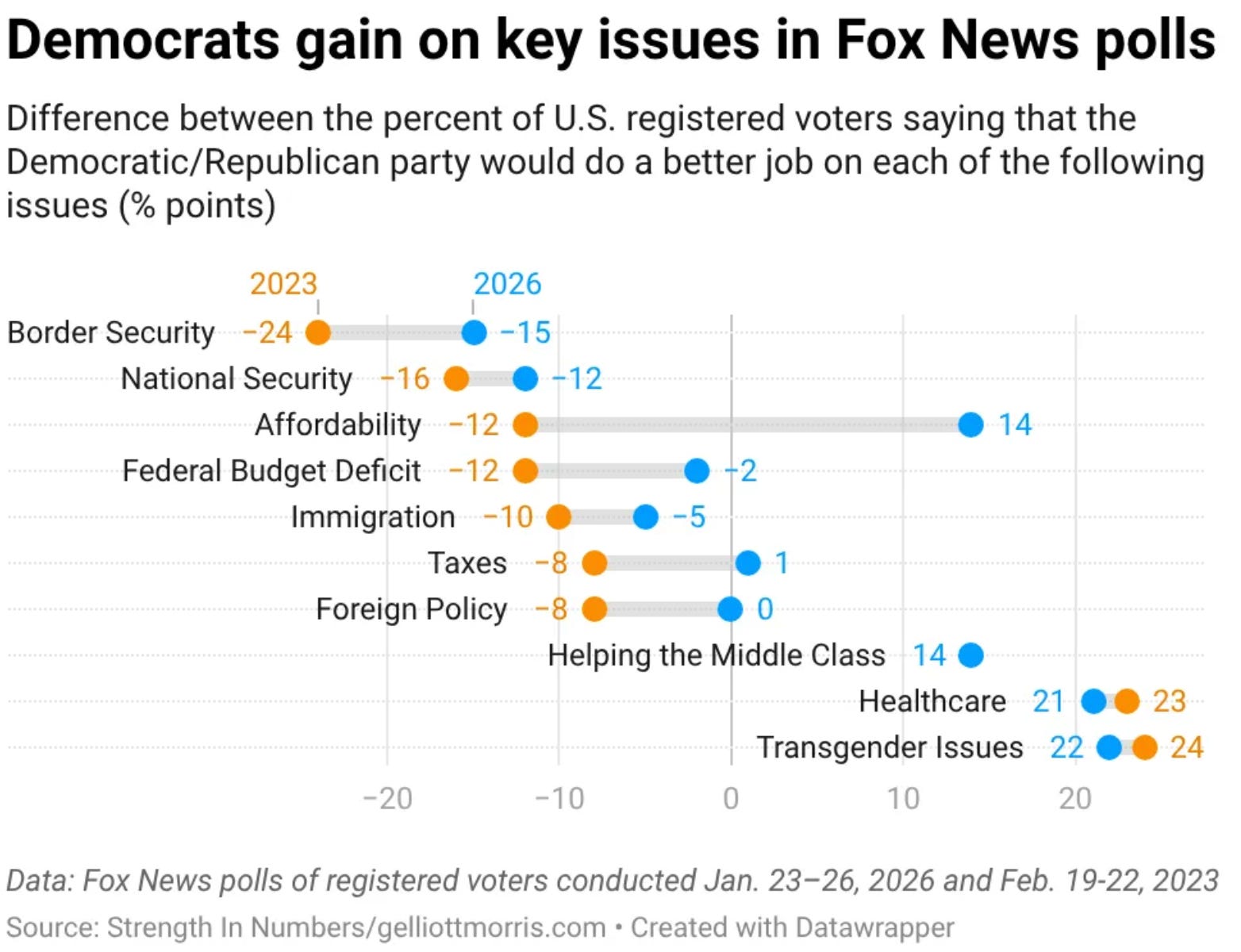
As it turns out Democrats are indeed more preferred on nearly every trans issue one can think of—other than the four specific issues on our timelines each week.
The far left helps dilute the distinction between those issues by reinforcing the Republican strategy. For instance, when top Democratic frontrunners like Gavin Newsom and Pete Buttigieg moderate their least popular positions and grow cautious about alienating voters, far-left voices quickly equate them with Republicans.

By suggesting there is no meaningful difference between the parties, the far left pushes moderates away from a coalition that visibly tolerates that kind of identity-absolutism and makes persuasion nearly impossible for voters who are open to broadly pro-trans positions.
In the end, the reflexive equivocation and intolerance of internal disagreement hurts trans people the most.
Trans rights are generally popular
The problems most trans people face rarely get the attention of the limited exceptions.
Most Americans support allowing transgender people to serve openly in the military. Voters are uncomfortable with heavy-handed government interference in private family medical decisions, even if they also disagree with gender affirming care for minors. Efforts to erase LGBTQ references from government materials or purge books from libraries are not popular with the general public. Discriminating against trans people in hiring and housing practices is thoroughly rejected.
To put transgender issues in a better light in Americans’ minds, Democrats need to shift attention to the most important challenges facing that group. Hint: it’s not trans athletes or gender surgery.
Thousands of books—many about gender and sexual identity—have been banned from libraries. Roughly one in five trans people attempt suicide in their lifetimes, and a similar share report discrimination in hiring and housing. There are more transgender people who served in the military than the combined number of minors who underwent gender-affirming surgery and trans athletes in women’s collegiate sports!
How voters view each party’s level of attention on these matters is also an important part of a political coalition. Diverting too much attention to winning or losing issues can be a problem, particularly when other more prioritized issues aren’t being addressed satisfactorily. In each of these areas, things simply look better for Democrats than Republicans—particularly because Democrats are in the minority and thus not “in charge” of any given issue.
Roughly 70 percent of Democrats and Democratic-leaning independents say Democrats spend either the right amount of time or too little time addressing transgender issues. Meanwhile, Republicans say their own party spends too much time on it—more than any other issue. Though Republicans have gained with voters since 2023, that hasn’t happened from narrowing of the gap—so to speak. Republicans consolidated voters who prioritized a set of the least popular issues while Democrats remained steady in preference overall.
The perception of transgenderism’s total collapse came from the frame of Republican campaign strategy and Democrats’ toleration of dogma, not from a mass ideological shift in tolerating discrimination against trans people.
Democrats: beware of whiplash politics
Democrats must not overcorrect by treating trans rights as radioactive. Doing so would also give the far left more reason to equivocate and the right a sense of vindication for their oppressive approach.
It’s completely fine to oppose trans athletes, but Democratic leaders should be careful not to make the few unpopular issues the only trans-related topics they ever discuss. Doing so would be missing a major opportunity to emphasize their military service, advocate for fair practices in business and education, and call out the stigmatization of trans people in civil society. If not, Republicans certainly won’t come to their rescue, and I don’t think the fight for equal protection should be left to people like Hasan Piker
With the Republican game still being played and the far left planting themselves on the hill of critical theory, the Democratic base is left to do what it can to support and protect trans people within a liberal system, where the rule of law prevails.
Democrats are by far the best (and possibly only) vehicle for Americans to help trans people secure the civil rights for which they are entitled. But to implement ideas that help trans people, Democrats have to win over those who aren’t already convinced.
Well said, although I have some thoughts. I tend to think Democrats should avoid the issue for a couple of reasons. 1. It's radioactive to normies 2. Democrats allowed the far left to poison the well and make it a radioactive issue.
The far left demands everything, yet gives nothing to the larger liberal cause. One policy deviation and you're a Nazi.
I'd advise Democrats to avoid the issue but have a canned response, "Trans people are people and deserve the same rights as everyone. At the same time, women only spaces should be respected and parents should have the final say over decisions about their kids. Next question." Opening the pandoras box will only invite the most ghoulish reply from the far left.
The problem is one of caring. The trans movement does not care about trans people, aside from their ability to raise funds. And the Democrat party does not care about the trans movement, aside from its ability to garner votes. An ability that has been sorely lacking of late.
None of the trans people I know are very interested in the “movement,“ and resent assumptions about their politics.
Enough said, because they are human beings, citizens, and quite able to speak and vote for themselves.