
Taking the stand in Fetterman's defense
The Democratic Party vs. John Fetterman

When John Adams defended the British soldiers after the Boston Massacre in 1770, he called it “one of the most gallant, generous, manly and disinterested Actions of my whole Life.”
Adams was part of a society that widely viewed the ruling British as authoritarians seeking to suppress liberty. This meant defending the British was a risk his family’s livelihood—and certainly his own reputation. Many patriots wanted swift vengeance rather than a critical deliberation of the facts. But Adams believed everyone was entitled to a defense and wanted American society to be one of enlightened principles; one that answered only to the rule of law and the state of evidence rather than the mobs’ preferences or authoritative command.
In defending the soldiers, Adams wrote that “facts are stubborn,” and that our wishes, inclinations, and passions—particularly Americans’ lust for punishment against the enemy—“cannot alter the state of facts and evidence.” He understood that justice requires defending reason, and that critical restraint over one’s own conclusions is a necessary component to that defense.
Like Adams, I too find it necessary to defend someone facing intense criticism and calls for punishment before the stubborn facts and evidence are fully considered.
Consider this a trial of sorts: The Democratic Party is alleging ideological treason on the part of Pennsylvania Senator John Fetterman.
I rise to his defense.
The accusation of misplaced priorities
What Fetterman’s accusers call betrayal is the political pragmatism necessary to win over people preferring the opposition. In competitive electoral regions, leaders who can win elections need room to exercise independent judgment—provided their priority is the party’s success—lest they become too pure for the broad coalition they built.
Fetterman represents a large Trump-won swing state. I haven’t seen evidence Fetterman has risked success for his party in Pennsylvania by taking popular positions. And nor will you, because his priority is winning elections in a purple state.
It is better to inquire about the priorities of his accusers.
Do Fetterman’s accusers prioritize total alignment from all their party members, or electoral competitiveness in all 50 states? The stubborn facts show that these two priorities cannot be reconciled: pursuing ideological purity undermines competitiveness, while prioritizing competitiveness requires tolerance of deviation.
One can argue Fetterman deviates from his party. No one will contend that. He will not contend that. However, it isn’t evidence of betrayal but of loyalty to the goal of Democratic competitiveness!
Should we not feel contempt for those accusers who continue to cling to failed policies despite repeated electoral rejection? Should we not demand that those far removed from the median voter positions resign or face primary challenges? Or is the accusation only applied in one direction?
Therefore the charge is not of disloyalty at all but of nonconformity and disobedience. Of that he is certainly guilty. Political coalitions without members guilty of the same charge is one without political power.
If we first accept that the party’s priority is competitiveness nationwide, then we can discern which critics undermine that mission. There is simply more evidence Fetterman’s accusers are undermining that mission than anyone else.
Disloyal to which priority?
To be competitive everywhere, a party must persuade people who do not already belong to it. Yet in their condemnation of Fetterman, many accusers seem willing to sacrifice effective leaders who attempt to broaden the party’s appeal and win more votes.
By any reasonable measure, Fetterman should pass the loyalty test with flying colors. He supports closing income tax loopholes for billionaires, supports labor unions and abortion rights, voted against the Big Beautiful Bill, and holds positions on LGBTQ rights that are more progressive than many members of his party.
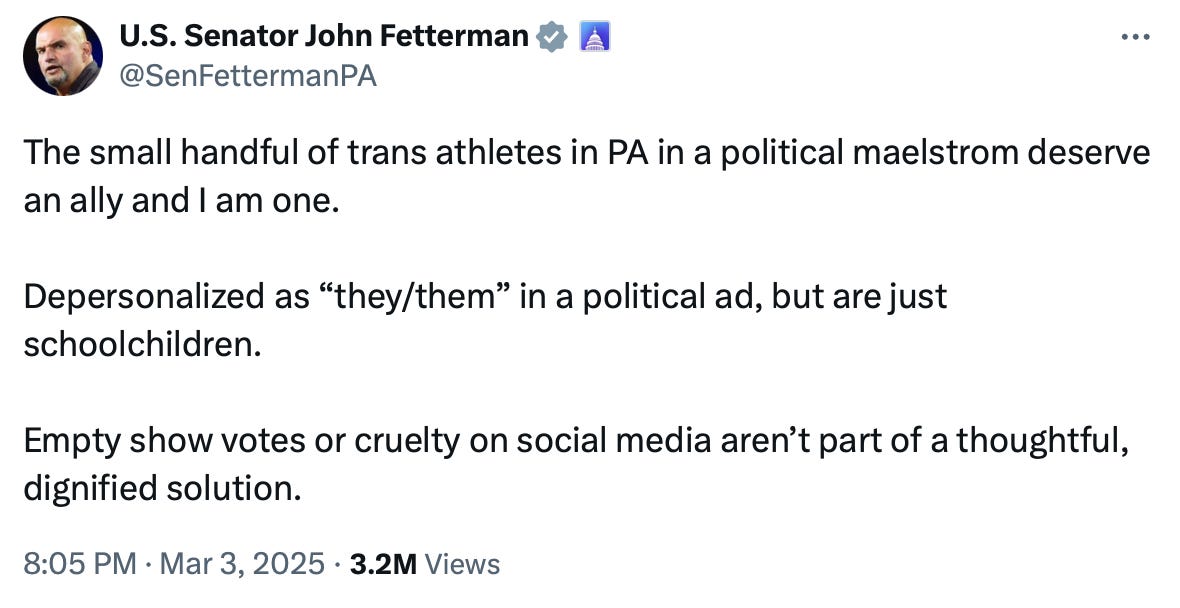
If we are to accuse someone of ideological treason, the charge must involve meaningful actions that obstruct the party’s ability to govern effectively or worsens its support levels. That description does not fit Fetterman. Unlike Joe Manchin or Kyrsten Sinema during the Biden Admin, Fetterman has not served as the “deciding vote” against major Democratic initiatives. He has not weakened Democrats’ support.
If the charge is simply that Fetterman votes with Republicans more often than Democrats would prefer, the same could be said for many House members who represent conservative districts. Take Don Davis, who has won multiple elections in a Republican-leaning district in North Carolina. No serious Democrat suggests expelling him from the party for adopting deviating positions.
To win in states like Ohio, Alaska, or Texas, the accusers will have to tolerate—and even encourage—strategic moderation from members who operate in difficult political terrain prioritizing competitiveness. That is all Fetterman appears to be doing.
Loyal to the wrong priorities
Can one be disloyal if the accusers knew about the deviations before initial acceptance? Because Fetterman has been this way since the beginning: he campaigned as a progressive in areas where he thought it merited, and more conservative in areas where he believed it deserved. This principled positioning is likely one reason he won in the first place.
Now, of course, things change.
But Fetterman has only sided with Republicans when public opinion supports his position, when his vote cannot alter the outcome, or when he believes Democrats have become overly dogmatic or hypocritical. These are all rational reasons to punch left. Even if one disagrees with his judgment, expanding the coalition in competitive states requires including members willing to challenge party orthodoxy.
The accusers do their best to make Fetterman an outlier by harping on his occasional deviations. They condemn relatively minor votes and disdain his willingness to punch left on high-salience issues, like immigration and foreign policy.
Yet consider what makes an issue high-salience: people are interested! And most of them prefer Republicans to solve those issues simply because the accusers don’t have anyone inside the coalition confronting the merits.
Are the accusers really comfortable enough to start rejecting people who think ICE should not be abolished, who doubt the urgency of climate change, or who believe the Iranian regime should fall? I’m not. Fetterman is not. Hell, the opposition isn’t either.
So who is acting disloyal to the cause of becoming competitive everywhere? The accusers themselves.
You can’t handle the stubborn facts
Like Adams before me, I may wish the political situation were simpler. But the facts remain stubborn. Democrats cannot win durable national power by demanding ideological conformity from every member of their coalition. They must tolerate figures who speak to voters the party base does not reach.
The evidence in Fetterman’s case is hardly damning: he supported President Biden’s agenda 97 percent of the time and currently enjoys approval ratings higher than Donald Trump, his Republican counterpart, and his Republican challenger in Pennsylvania.
The individual accused of ideological betrayal is also one of the partys most electorally viable figures. Defending someone for exercising independent judgment in ways that strengthen the party’s coalition is a defense of political reason. And, like Adams taught us, a defense of facts over passions.
Democrats must tolerate and embrace principled defections from ideological orthodoxy. That is, unless they’re satisfied with riding shotgun as MAGA Republicans grab the wheel.
The Defense Rests.
Good article. Until democrats jettison "the groups" or at least muzzle them, they will keep being linked to the far-left activists that drive away the normals
A necessary take but every defense needs a prosecution. The most fundamental thing a Democrat can stand for is democracy, and Fetterman has failed that test repeatedly.
Fetterman was the only Democrat in the Senate to vote against the war powers resolution to reign in Trump on Iran. This is a war that almost every American opposed before Trump launched it, and still most Americans oppose even now. Is an insane war with no end strategy and in which the administration has failed to demonstrate that it can avoid civilian harm to a reasonable degree. It was done in violation of the Constitution as there was no emergency to justify article II powers, but by failing to advance the resolution Congress has given it cover.
Take Republicans out of the picture for a moment - this vote is unacceptable in a democracy. Adding the existence of Republicans makes it "bipartisan". But that doesn't make it a reasonable vote. It's a vote for dictatorship.
And it's far from Fetterman's only pro-dictatorship vote. He voted to confirm Trump enforcer Pam Bondi as head of DOJ, instantly converting the agency from an independent law enforcement department into part of Trump's personal crime family. It's now known for political prosecutions of Trump opponents and news reporters and for covering up the Epstein files, and Fetterman voted for that. He also voted to keep funding DHS after the killings of protesters in Minneapolis.
What Trump abuse of power is too much for him to support? I ask that honestly. Has he voted against a single one? Fetterman will "bipartisan" us into a one-party failed state.