
Roy Cooper: the fighter without much of a fight

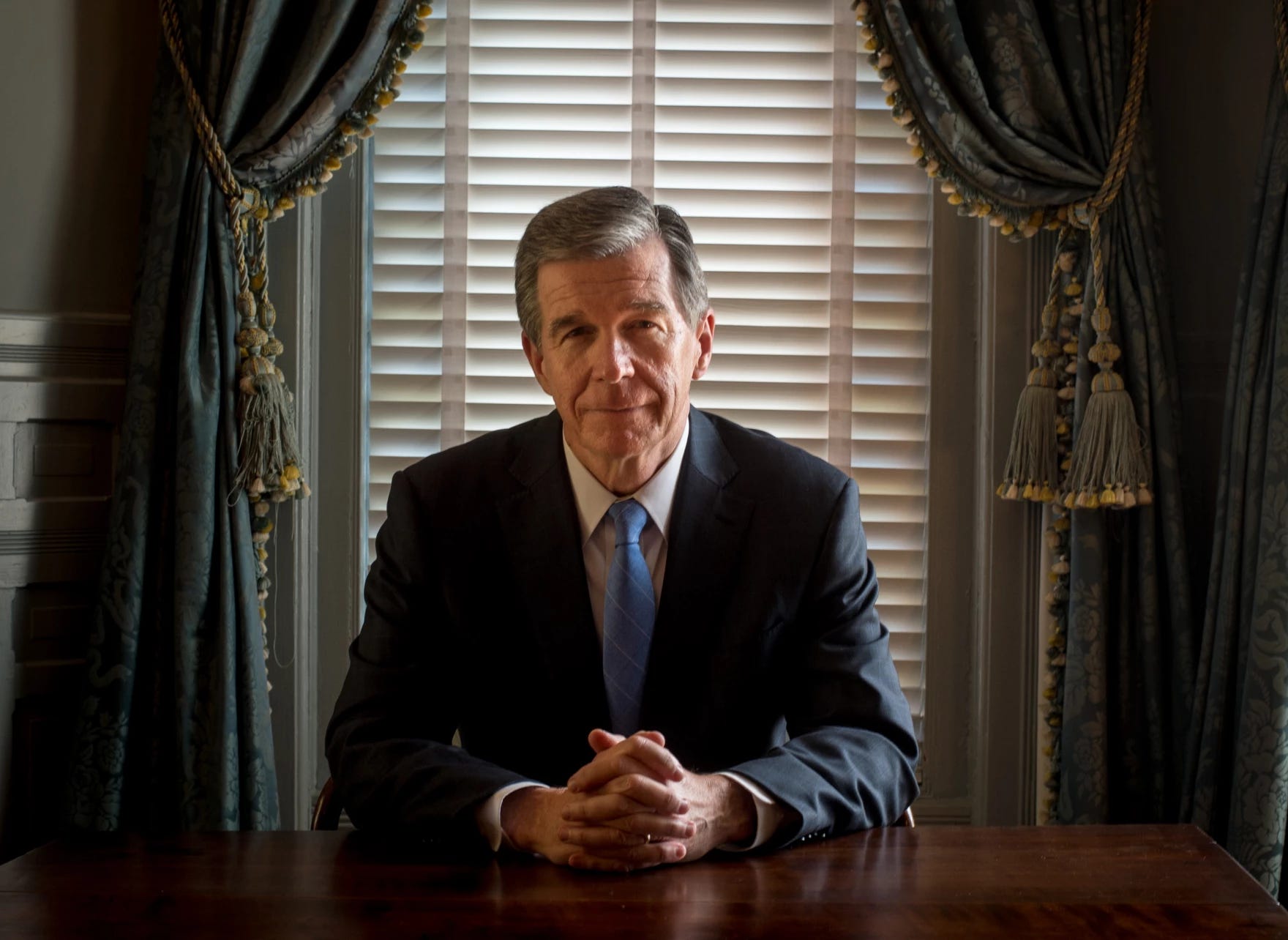
One nomination, one candidate
It’s true: Democrats didn't have a proper primary battle in the midst of the chaos of 2024. But it is also true that there are plenty of elections where the nominee didn't have to compete, became the winner by collective decree, and no one seemed to care.
Roy Cooper in my home state of North Carolina is one example.
Wiley Nickel, the one Democrat positioned to contest the nomination for NC's Senate seat left by Republican Thom Tillis, dropped immediately after Cooper announced. With no one else daring to 'Duke' it out, Cooper became the definitive nominee essentially the moment he filed (and more precisely, well before he filed). Compare that to what Graham Platner in Maine, James Talarico in Texas, and Abdul El-Sayed and Haley Stevens in Michigan have had to do: define themselves in public, under intense scrutiny from their own party members, because the competition forced them to explicate on a number of highly-controversial topics.
Because they had a public intra-party purity battle, I know El-Sayed campaigned with Hasan Piker. I know Platner was accused of a bunch of horrendous sexual misconduct and has a Totenkopf-style tattoo on his chest. Talarico used to say God was nonbinary.
El-Sayed seems to have hit his peak. Platner suspended his campaign. Talarico had to walk it back.
But what can you say about Roy Cooper—good or bad?
It is a privilege to skip that unnecessary screening entirely. Clearing the field is quite easier for a strong candidate, but it ought to be more of a common strategy in Democratic politics, particularly in a more competitive district and state. Democrats treat clearing the field as an act of deference to a favorite—the elites pulling one over on the people—rather than a tool to gain an advantage against the opposing party. Rid yourself of the primary process, or find a candidate who will force competitors out early in the race, and you can dedicate your entire campaign to beating the actual opponent rather than posturing your purity to win over people likely to support you anyway.
Because of his solo-run, Cooper has enjoyed room to spout on about "affordability," rather than a specific position on Israel-Gaza, the skeletons lurking in his closet, or whether God's gender is indeed binary. Cooper himself clearly thinks that's a good thing because he hasn't voluntarily offered a bunch of specific propositions on various cultural issues of our day. His campaign slogan is: "Make stuff cost less".
"Make" meaning what, by force, or some kind of legislative regulation, or through laissez-faire economics?
What "stuff"--housing, cars, food, energy?
"Cost" in terms of time, money, job benefits?
Does "less" mean the price goes down, or my wages go up, or both?
Like many in the political space have figured out, and the commoners still making their way, the whole "affordability" schtick is almost entirely composed of virtuous platitudes that make working class people feel good but doesn't really possess any substantive policy framework, much less a criticizable one. And though I fully agree candidates should avoid granting any specific policy or decision before they are faced with the actual decision, it is true that the milquetoast offering of 'making stuff cost less' fits the populist, cynical mentality plaguing modern politics on the left and right.
But because Cooper isn't aiming to 'out-populist' his own teammates in a primary, he's not forced to trace his ideology or any specific policy proposal before reaching the critical stages of the election.
Thanks but no thanks
The best example of Cooper's decision-making may just be declining to be Kamala Harris's running mate.
At the time it read as a lack of appetite. In hindsight it looks like the correct read; he had every reason to keep his distance. Cooper remained a known quality to his own voters, and a stranger to Washington's. In one of his latest campaign rallies, he makes that posture sharp by asserting he would take "some good old North Carolina common sense to Washington."
The decision to stay out of the national light when Democrats were their least favorable provided much-needed separation from the Biden-era politics, didn't coerce him into laying out a bunch of policy positions that would come back to bite him, and prevented the then-Republican lieutenant governor—and nut-job—Mark Robinson (Trump called him MLK 2.0) from linking arms with the Republican super-majority legislature and taking full control of the already-heavily-gerrymandered state.
It also stopped Cooper from becoming a fixation of the rabid retributive gang of buffoons also known as MAGA, like they did with Tim Walz almost immediately, and continuously, until the bitter end of his political career earlier this year.
Though Cooper knew he was seriously contemplating running for Senate, his prudence in this one decision impeded so many other problems from arising. And while I think the Harris-Cooper ticket would've gotten more votes, the strategy he utilized seems to be working out given he's leading all other Senate Democratic candidates.
But unlike many others vying for a Senate seat on the Democratic side, Cooper faces a state party who for the life of them cannot find a decent candidate.
Oh, brother, this guy stinks
Republicans lost gerrymandered NC-1 congressional district to Don Davis, a black Democrat, in an arena Trump carried three times. They lost the governorship to Josh Stein over Mark Robinson, a candidate so toxic he moved actual Trump voters to vote for the Democrat in Josh Stein. And this last spring, Senate leader Phil Berger—the most powerful Republican in the state—lost his own primary to a local sheriff, despite a Trump endorsement ostensibly bought with the promise of another gerrymandered district (which he delivered) and more than $20 million in spending.
Michael Whatley, the man Cooper actually has to beat, fits that same mediocre pattern.
Whatley is a Michigan transplant and former RNC chair running as a pure vessel for the MAGA agenda, with nothing distinctly independent to offer. Cooper inherited the foe and can take advantage of his hallow nature. After presenting himself as a bastion of North Carolina professional sports, he was found out to be creating fake players using AI when pressed on specifics. Since then, Whatley’s campaign has clamped down on the largest state media outlets being able to attend his rallies, given their alleged bias against him (I'm personally looking to attend one soon since I have yet to be banned).
But I must be cautious not to over simplify it, as I too often see people do. Cooper is by no means running the table. North Carolina is a red state at heart that's moving blue more each day by the sheer number of individuals moving to the major metros, and polling says Cooper's success should come with an asterisk.
Cooper was up roughly seven points through late June, tracking the generic Democratic environment, and one poll had him up fourteen, but even there he was sitting at 48%, which is close to where he's been most of the race (and close to where Platner was before his campaign collapsed entirely). The most recent poll finds that Cooper continues to lead but only 48-44. Cooper appears to have a ceiling near 50%. That's enough to win—certainly. Yet a ceiling all the same.
With as much advantage in the environment as Cooper has, and as much as Democrats are relying on him to lead the pack (meaning his race is an indicator of how Democrats will perform overall), the fact Cooper seems to be just over or roughly even with the generic congressional ballot doesn't make for a super-optimistic, enthusiastic outlook.
The fighter without a fight
Democrats want a fighter; a word that’s become more or less just another meaningless emotive, thrown around by every candidate in the primary cycle. No doubt, Cooper is as much of a fighter as one can imagine: he vetoed 104 bills, nearly three times the combined total of every other North Carolina governor since the veto was created. He blocked abortion restrictions, bans on gender-affirming care, expansions of gun access, and efforts to force cooperation with ICE. He responded aggressively to COVID-19 by closing schools, issuing stay-at-home orders, and mandating masks while Republicans accused him of abusing emergency powers.
But it’s also true that Cooper’s campaign seems built to obscure. He’s a candidate with plenty to say, but who has decided the state won’t reward him for saying it—even if the national base does. That’s the right decision. He’s made a career out of fighting Republican elites in power, not charting an ideological course.
At the same time, Cooper has a long record of working across the aisle because he had to. The constituencies he needs to win a Senate race—rural, business-friendly moderates, disaffected Republicans, ticket-splitters—do not reward rigid ideological purity, particularly not one calibrated to a national platform.
So while the vagueness innate to “make stuff cost less” is providing cover for an ideological fighter dressed up as a common-sense outsider, Cooper is doing the right thing by presenting himself as a humble alternative rather than a defining leader of progressivism. ‘Don’t like the cost of living, tired of Republican rule? Vote for me—the ol’ country boy just trying to help common folks’. It’s not a message for political-heads like us, but it may just be enough to take over a seat Republicans have held for nearly two decades.