
Republican's can't rely on Trump in future elections
The GOP has no plan B

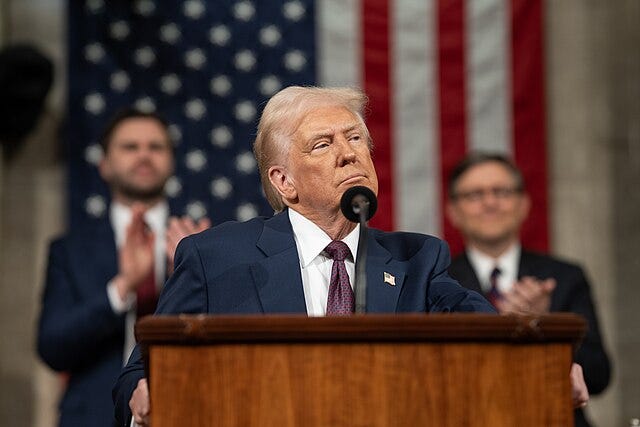
Last week, as I casually watched the tail-end of Trump’s ‘Liberation Day’ announcement, a Laura Ingraham segment popped up on screen. She was joined by a senior adviser for the Trump 2024 campaign, Jason Miller, and they were discussing the results of the Wisconsin Supreme Court election. Though Miller made time to sift through each MAGA talking point about outside funding while blaming the losing candidate, one thing he said stuck out to me: “President Trump was not on the ballot, but abortion was”

Red states like Kansas, Kentucky, and Ohio showed the significance of not having Trump on the ballot as an election centers on a Democrat-advantaged issue: it inherently limits Republicans' support. However, state-wide referendums are very specific to how state residents feel about a particular issue. To understand the full scale of the Trump effect on Republican electoral chances, we need to analyze a broader pool of results.
It’s not as bad as you think
Democrats are not in the mood for a lecture about why they should be optimistic right now. But here at Open Society, we do our best to identify problems and put creative efforts into solving them; that requires — at minimum — an attitude of believing you can! And though I reject historicism, induction, and inevitability, I think Democrats’ electoral problems will be much less severe as time passes.
So, what’s the big problem for Democrats right now? The country has moved to the right since 2012 and the once large and diverse Obama coalition has splintered. With Republicans in each branch seemingly drinking the MAGA Kool-Aid en masse, Democrats are left debating amongst themselves what they can do to become viable in the next election. Some of the ideas, like party officials taking common-sense policy positions, ushering in a pro-growth neo-liberal mentality, or some combination of the two, are good. Improving the party platform and attitude is required for Democrats to shake their unfavorable stereotypes. But something that is not being discussed enough is Republicans’ problem of winning elections without Trump on the ballot!
Of course, I must concede before getting too deep in my argument that it is entirely possible Trump will declare himself King in 2028, his Admin and fans support it, and we enter a new dystopian age of American history. But in our framework of optimism and progress at Open Society, we won’t get too bogged down about that pessimistic slippery slope. Nevertheless, Trump represents an exceptional case for getting voters to the polls and maintaining enthusiasm.
The whiff of failure
In the 2022 midterms, Democrats were expecting a decent-sized Republican comeback, given Biden’s lack of approval and Trump being somewhat quiet since January 6th.
Trump’s lack of spotlight worked in Democrats’ favor. It also helped that the few times Trump did come out of Mar-a-Lago was to endorse far-right election deniers, many of which lost their elections. But those results only told Republicans to stop touting election denialism, not that Trump was the problem: and paradoxically, they were right. Two years later, Trump won the White House again with his best approval ever, pulling up Republicans to a majority in Congress. However, Democrats outperformed the presidential ticket in several key Senate races in 2024 because down-ballot GOP candidates received decidedly fewer votes than Trump, despite Republican turnout increasing from 2020.
In Michigan, Nevada, Wisconsin, and Pennsylvania, Republican Senate candidates received tens, and sometimes hundreds, of thousands of fewer votes than Trump. Three of the four candidates lost their elections and the one winner — Dave McCormick — relied on roughly 15,000 votes to push him over.
It's possible a different GOP presidential candidate could have performed better than Trump, but the data from these four states indicates that hundreds of thousands of Trump supporters were primarily interested in voting for the top of the ticket, leaving the rest to fend for themselves.
A few months ago, I wrote a piece for the University of North Carolina at Chapel Hill paper explaining why the destruction of Republican Mark Robinson’s campaign should give Democrats optimism about their electoral futures. My point in that piece is similar to my argument here: other Republicans don’t have the same advantages, skills, or cult-like loyalty as Trump. Republican voters, though unevenly, do use their moral compass when evaluating potential political leaders. So, while Trump won the state by 3 percent, Robinson lost by 15 and received fewer votes than any Council of State (NC state executive cabinet) major party candidate. Without the stable genius, Republicans are a crew without a captain.
An inadequate long-term strategy
One of the big problems I had with Republicans rallying behind Trump in the 2024 primaries was that choosing him would be politically advantageous only for the moment, not for long-term ambitions of the party.
Besides my own quarrels with Trump, he was an objectively undesirable candidate: he was twice-impeached, nearly convicted in the Senate for his influence on January 6th, under criminal investigations, found guilty of 34 felonies, liable for sexual abuse, and never apologized or corrected his mistakes from the first term—the real ones anyway.
Not only was Trump very polarizing and dishonest, he could only be in office for four more years! If Republicans had chosen a DeSantis or Haley, the general election would've been difficult, but likely a contest against Biden—an easier opponent. If they won the election, the party would be in a much better position to ride the wave than they are now with Trump on his way out. He has already — in eight weeks — sent the economy into a downward spiral, and Republicans are losing ground in swing states like Wisconsin and in safe-seat districts like Florida’s panhandle in off-year elections. By sticking with Trump, Republicans ensured a fight for leadership in two to four years. And with the premise that Trump will retire, even if still offering endorsements, Republicans will be in a much worse starting position than they would otherwise be without him.
With Trump's policies on tariffs and deportations causing shockwaves across the nation and the West, Republicans' narrow majorities in Congress, and Democrats becoming more centered and staying away from the spotlight, they have a real opportunity to regain power in the midterms and beyond.