
Reflections from a city worth preserving
Celebrating 250 years of preserving progress

The summer of lovers
As heaps of activists plunged into U.S. cities to defend the value of black lives, I made my way to Washington, D.C. (the nearest city with any real chance of something notable ‘going down’) from just outside the old capital of the Confederacy that is coincidentally tucked in the heart of the State for Lovers.
The moments-notice trip was spurred, in part, by the roaming invisible illness that had emptied the streets for the past few months and left us with little to no responsibilities in our quarantined enclosures. I think the virus was partially to blame for why my typical concern of being at the ‘wrong place at the wrong time’ never quite kicked in; that is, until I was already in the midst of the Federal City, reading a notification informing us President Trump was being scuttled to the White House’s underground bunker by Secret Service.
As protesters and officers formed opposing lines on the lawn, teargas and rubber bullets pushed into the encroaching crowd—the first of which seeped into my swiveling eyes and the second into my right calf—as I ran backwards from the cause of the chaos.
I asked to get out of the house and into some good trouble. Ye, indeed, received.
The dashing crowds, smoke filling the air, the look of terrorizing determination in the faces of those both protesting and those defending public property. It was an illustration of our nation’s institutions under intense turmoil, and the active grunt-work required to defend the functionality of that slow and often rancorous process to achieve something better.
A proof that Washington D.C. does not produce typical moments; that, I suppose, was precisely why I found it so fascinating.
A day that will live in ignorance
I wouldn’t step foot in the area again until fall of 2023, the purpose of which was to fulfill my patriotic obligation to tour the various monuments, memorials, and museums presenting the leading expressions of our blessed birthright.
As someone who’d like to be thought of as something of an aficionado on matters of American history, particularly of the Founding Era, my disappointment almost immediately made itself known. I was troubled by how pitiful the sights were, and even more so, my own lofty expectations of them.
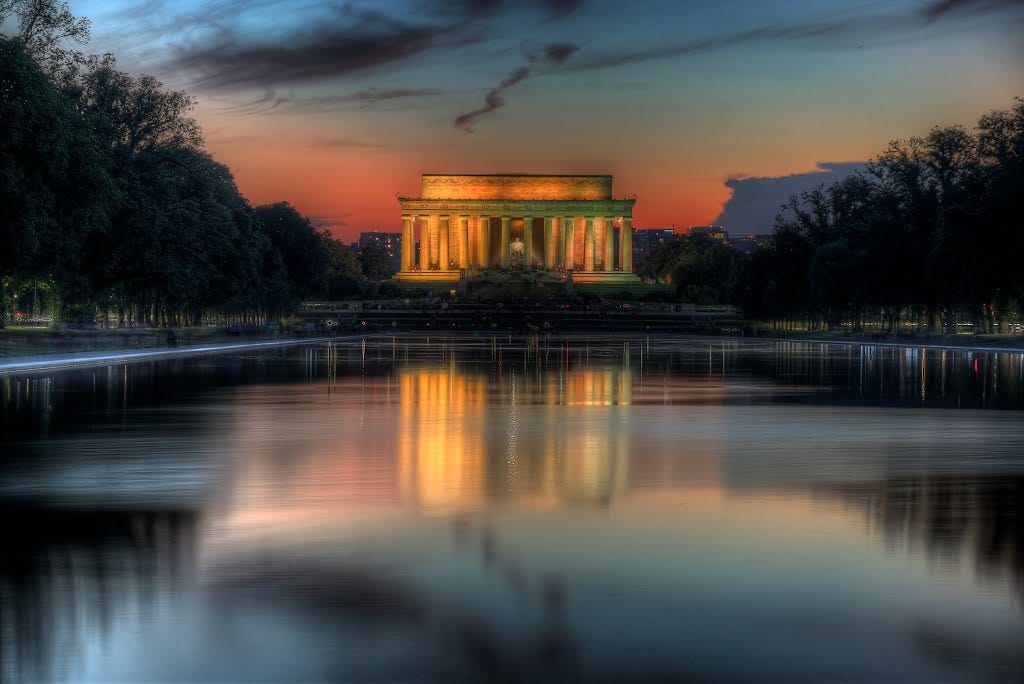
Once upon the steps of the Lincoln Memorial, peering down on the scores of people making their way up and down the dusty pedestal, I couldn't help but notice distinctly Indian families in traditional cultural garb, Spanish-speaking parents urging their kids to retain a sense of self-control—impossible to take a step or find a corner where your protruding rear or aghast half-smile wasn't featured in someone's background. A step outside Mr. Lincoln's chambers one could hardly read the words on the side due to the dirt in the crevasses. The Washington Monument fared no better in the distance. The Reflecting Pool (where Martin Luther King once recalled to us his lack of sleep the night before) was just more evidence my fanciful imagination had gotten the best of me.
People had traveled across oceans and continents to witness the American embodiment of characters whose ideas sprung from Enlightenment values across the pond and great minds further east, just to find the sculptural and pictorial record of their legacy left to decay in the open air for all to ponder in suspicion. And though lacking the boisterousness of the first visit, my second tour of the third and definitive United States capital was unsettling in its own quieter way (yet no less untypical for it).
The disappointment was nevertheless shafted as I eventually learned my internal quibbles regarding the national heritage sites would turn out to not be the main significance of the day.
It happened to be the morning of October 7th.
The internal distress I felt touring our institutional architecture was, at that exact moment, being more acutely felt by millions of people dealing with threats the very freedom I possessed had left me wholly ignorant of (and presumably by scores more who have since found me amongst the extras in their vacation photo albums).
Questions of aesthetic upkeep and civic symbolism in America’s capital simply cannot occupy the center of political reality as we Americans are accused, and quite guilty, of allowing. We the people are not wrong to care about the condition of iconography; but we can and do temporarily mistake the maintenance of symbols for the substantive condition of our Republic. But civic infrastructures like the Lincoln Memorial and the Washington Monument (and yes, even the Reflecting Pool) only fail in significance when the meaning behind them is no longer maintained. The hard work of preserving the Union takes precedence, and it is that precedence that allows the concrete (and marble and bronze and granite) of history to accrue dirt rather than be abandoned, plundered, or dismantled.
A culture of maintenance
In his 2009 Vanity Fair essay, Christopher Hitchens noticed something particular about Washington’s relationship to grandeur: that the city “is and always has been irretrievably bogged down in process, and process doesn’t generally make for electrifying prose.”
Like many of Trump’s ideas to Make America Great Again, even in the world of aesthetics and construction, I possessed a sense of pitiful sympathy for the president’s impulse. The White House, our historical monuments, our statues, the Reflecting Pool—should ideally rank among the wonders of the world. A true cynic may even think we Americans are a materialist people in a materialist nation; we deserve some pleasant materializations that reflect our true prosperity.
But one ought to notice the president’s approach to the capital renovation is imbued with a philosophy that desires definitive completion: The East Wing demolished to make way for a ballroom, the Rose Garden paved over, a 250-foot triumphal arch initiated along the Mall, and the Reflecting Pool fiasco. Trump embodies the materialist gratification innate to Americanism but with that cynical twist: the stubborn insistence that greatness is a destination rather than a condition requiring tending. The idea we renovate our way in posterity the same way you’d flip a property in Queens is a peculiarly populist confusion, and one that the president wears more literally than most.
The confusion mistakes an act of redesign for a culture of maintenance that requires consistent and critical upkeep over long stretches of time.
Trump is gesturing at a Golden Age without putting in the work, based on the assumption that politics, like real estate, can be perfected through decisive intervention (by him anyway).
But the dirt in Lincoln’s crevasses and the algae impeding my reflection are failures of sustained attention rather than momentary acknowledgements of it being overdue. What our capital sites demand is the same as with any of its citizens: the stubborn protection of a civic culture that demands solutions and cumulative work across generations. It's what those we chisel into marble spent their lives doing since 1776: tending to the conditions that make monuments and memorials worth building.
Reflecting on American progress
My first visit offered scenes that Hitchens might reluctantly say calls for “electrifying prose”; institutions under visible, immediate strain. My second confirmed his actual point: a city “irretrievably bogged down in process”, its monuments left to show what has already been achieved through that process.
Both showed a nation in the unglamorous work of keeping itself alive.
The Reflecting Pool bridges the founding of the nation and the preservation of the Union. Its significance will remain so long as its meaning does. That people cross oceans to stand before it, that we retain the freedom to be embarrassed by it, criticize it, or worry with it at all—lies its true significance. Not the drool, mud, and bird feces.
And yet, it ought not require a mob-boss executive obsessed with real estate to cause national attention to these structures. The 250 years of arduous conservation—our Constitution, our institutions, our achievements—have produced the conditions under which that worry is still possible, that improvement is still feasible, and that the work of tomorrow remains ours.
I think that freedom is itself worth tending to.
We must treat the maintenance of our nation’s symbolic edifices, like our political and cultural institutions, as a ongoing practice. The preservation of progress—grime and all—certainly makes for electrifying prose.