
Promise fulfillment is a bad metric of good governance
The case against taking promises seriously

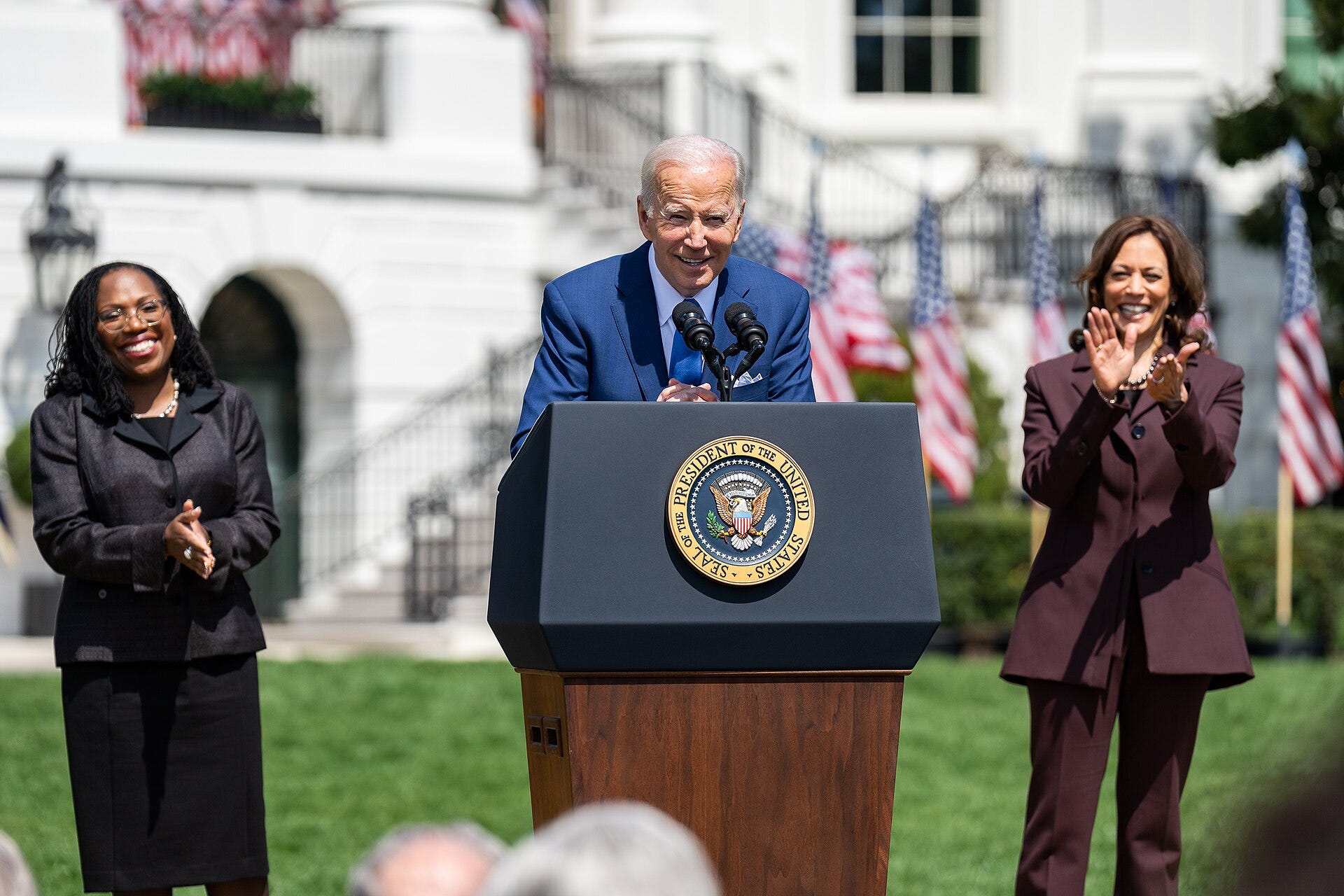
Biden promised to be a bridge to a new generation of Democratic leadership. But what did that mean, exactly?
The only way he could literally break that promise is if Democrats never win again. Yet almost no one would say Biden fulfilled the promise in a meaningful way.
One could argue Biden swatted away whispers of being a one-term president and rejected all useful opportunities to be one, thus failing to execute. One can argue he did step aside, is no longer the leader of the party, and that a new generation of Democrats is en route—fulfilling his pledge (even if in chaotic fashion).
What’s strange about campaign promises is that contradictory judgements of its outcome can all be rationally made with the same set of facts. Even though each of these interpretations of Biden’s version of ‘What Happened’ are defensible, the claim that he both kept and broke a promise simultaneously is not. Given each of these claims are indeed accurate iterations of American political history, it seems the problem with the assessments of promise-deliverance is they don’t add insight into whether the decision was correct.
That’s because political promises that are thrown into the political machine are most effective when they’re elastic enough to stretch over almost any outcome; ones that can be continuously reinterpreted (or more accurately, continuously excused).
What more could you ask for from a politician than a set of vague prophecies about specific decisions in moments that haven’t yet arrived?
The collective enchantment around measuring these prior commitments in politics reeks of the centuries-long apologism by evangelicals who argue the very same text can be treated as both a precise prophecy about the present (the United States in Revelation) and a document too historically bound to speak to modern specifics (tolerated slavery). Prophecies operate the same way in politics as religion: they are stretched to fit whatever outcome needs explaining without leaving oneself exposed to potential criticism for incompletion.
But as philosopher Karl Popper pointed out in his book Conjectures and Refutations, “a theory that explains everything explains nothing.”
The fact that a political candidate makes a promise neither explains their ultimate decision and its effects nor whether they honored the initial commitment. And even these are distinct inquiries requiring invariable accounts.
I think this is a merited case for not taking promises from political figures too seriously (and especially not literally). It is also why ‘promise-tracking’ so often collapses into selective interpretation rather than genuine accountability for politicians; it offers an unfalsifiable standard applied selectively against a prediction made about the innately unpredictable future.
When reality meets assumption
What’s really driving the criticism surrounding Biden’s messy political departure isn’t a broken promise, but a set of assumptions people made about his intentions.
Those expectations were entirely composed of wishful projection—and I say that only partially disdainful, because the audaciousness of assuming one's preferred outcome is immune from the innumerable pivots of reality is its own kind of delusion. As if Biden's political standing was always going down the tubes; as if Republicans would have no choice but to offer a weak opponent.
Criticism surrounding Biden’s ‘Indecision’ is really about a belief that Biden misjudged the moment—that he stayed too long, narrowed his party’s options, and passed up a better strategic path time and time again.
But notice how one can make these arguments without ever mentioning a pre-determined commitment. That’s because true accountability resides in conditions of uncertainty and incomplete information. And in order to focus on more practically-relevant subjects, like how a politician faired in the ring with his own invisible shadow, we need to replace relativist accountability of promise fulfillment with a universally critical evaluation of political outcomes and its handlers.
The disappointment in Biden thus cannot be about his failing to deliver on a promise—or even his intention—to be a one-term president (most notably because he never made such a promise). The collective critique of Biden operates as intra-frustration that an opportunity was not realized, and the realization we are each at fault. It’s a projection of accountability to oneself.
Improving ideas requires breaking promises
When I began writing this, I was targeting the ambiguous assertions by political candidates who promised everything and offered nothing simultaneously. But, so I thought, it’s always beneficial to be more-specific.
It’s a good rule of thumb epistemically, but in politics I’m not so sure.
Making specific decisions about a future belonging to shifting minds and culture is how Trump ends up telling NBC he never said he wouldn’t start any wars. He was lying, obviously, but the real critique should rest on his making the promise in the first place rather than his noncompliance or lying about it.
And here’s the catch-22: commitments dripping in ever-more specification slowly dims the scope of future opportunities to fulfill them while inadvertently providing additional opportunities to attack it. Not to mention the self-imposed constraints politicians place on themselves (as well as voters on themselves) in their ability to make decisions in the future.
Matthew Yglesias’ piece arguing against politicians having “lots of plans“ was the main influence on my writing here. He makes the case that the promises are a performance, and that locking yourself into specific policy commitments unnecessarily boxes you in—requiring a load of political capital in getting out. He thinks that makes for bad politics and I agree.
But it is also bad for accountability.
Most successful promise-makers frustrate their opponents and make supporters look foolish precisely by making unrealistic promises they never intended to fulfill, and those who make ambitious promises—and tries to fulfill them—end up forcing our bad idea onto our remorseful souls. Biden’s pledge to appoint a Black woman to the Supreme Court invited more criticism as time pressed forward. Trump’s promise of universal tariffs worked similarly in how the fluidity of politics overwhelmed the stasis of his prophecy.
These examples show how specific promises are more-falsifiable in structure, but that same detail is what makes them devastating for the ones uttering it. Inevitable shifts in reality morphs the feasibility to fulfill previous imagination.
At the same time, the more detailed the commitment, the more opportunities there are to attack it. Trump’s tariff pledge came laden with the who, why, and by how much. Biden’s Supreme Court commitment sprang from genuine cultural concerns. But specificity correspondingly invited more criticism than it was worth and left little room to adapt when reality pushed back.
Vague promises are better for politicians but create more problems for voters, given their uselessness as accountability tools. A promise broad enough to stretch over almost any outcome leaves too much room for irrefutability. It can be fulfilled or not depending on a particular set of facts, or by entire interpretations that are all simultaneously true—tying back to the instability of Biden’s “bridge.”
Accountability gets trapped either way: specific promises constrain governance and arm critics and vague ones are meaningful only to the captive audience laboring through the fruitless spewings on The View or Gutfeld!
The format of accountability in politics is broken regardless, which suggests the problem is that promises, pledges, plans in politics is nothing more than indications of a momentary appetite. Invoking past promises contaminates present decisions by replacing the question of whether something worked with the question of whether it was predicted. Those are not the same inquiry; one is useful for learning, the other is useful for tribal bickering. Politicians are rarely the ones actually held accountable for broken campaign promises. Instead, it’s those who took the promises seriously who end up accountable for their own inaction, even if they project it onto promise-makers.