
Nobody is preventing black Americans from voting in the South
Jim Crow is over. It's time to vote.

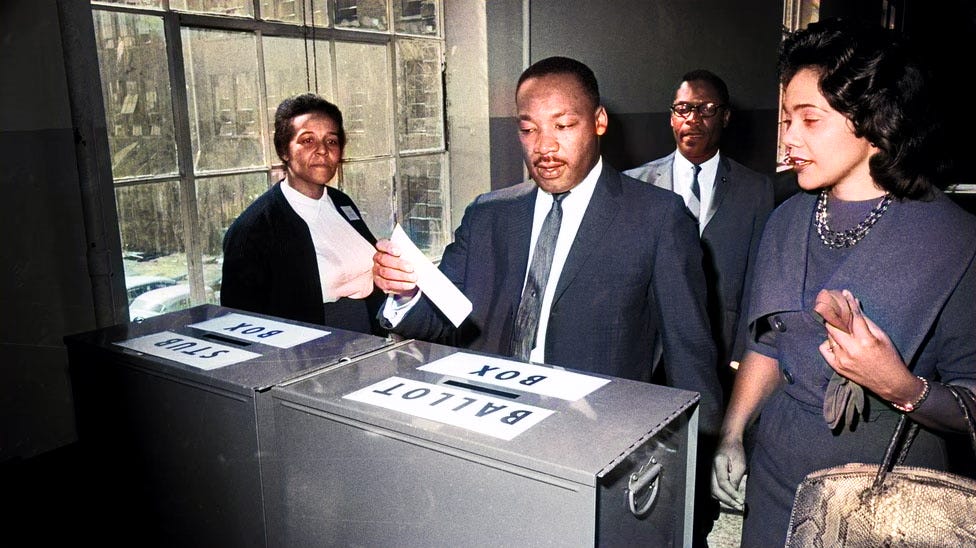
Democrats have got to stop telling black Americans the system is irredeemably rigged against them. And black Americans must stop believing them.
SCOTUS recently narrowed the Voting Rights Act by ruling that to prove a congressional map is racially discriminatory, one must show the state intended to discriminate by race, not merely that the outcome disadvantaged black voters.
Democrats far and wide—particularly in the South—did what they do best: began telling their voters the electoral system was racist, suppressive, and even violent. They didn’t say this explicitly, of course. No, they began doing it in a more cynical fashion: by comparing the effects of the latest ruling to suppression under Jim Crow.
Since partisan gerrymandering is perfectly legal, and black voters vote Democratic at rates hovering around 90 percent, a state can now draw lines that functionally dilute black voting power and defend it simply by saying “we were targeting Democrats.” And it would be a fair defense! My main concern, however, is that it seems to create a legal paradox: plaintiffs must prove race was the primary factor in drawing the map, but if they use racial data to build a corrected map for the court, their evidence risks being deemed legally tainted. But I’m no legal expert, and it’s possible I have that aspect misinterpreted.
Even so, Democrats have obviously lost their touch when it comes to ‘fighting the power’.
Former Georgia state representative Stacey Abrams had the right idea back in 2013 when she created the New Georgia Project, which registered hundreds of thousands of mainly young minority voters, building precinct-level year-round contact programs rather than waiting until the summer before the election. The project paid off and is widely credited with flipping Georgia’s two Senate seats in 2021 and turning the state into a genuine battleground.
Abrams, for all her faults, proved that a minority-heavy Democratic coalition can overwhelm a partisan map and place the first black U.S. Senator from Georgia. She saw the growth of the state and the appetite for real political change. And the state of Georgia achieved it by working together.
If only Abrams and other Democrats had learned a lesson from all that. Unfortunately they took another route in the wake of SCOTUS’ ruling on the VRA:


Justice Elena Kagan even asserted the ruling will lead to “the largest reduction in minority representation since the era following Reconstruction,” as though electoral outcomes are decided by cynical prophecy rather than who shows up to vote.
The comparison to Jim Crow, Reconstruction, and the general pessimism Democrats have presented to their base doesn’t hold up under even the lightest scrutiny. And black Americans’ own history should make that comparison offensive.
For instance, Medgar Evers was a black World War II veteran who had just fought at Normandy and returned to Mississippi in 1946 to vote when twenty armed white men, some of whom had allegedly been his childhood friends, showed up to threaten him at the polls. He left without casting a ballot, fearing for his life. And in 1963, he was assassinated by a white supremacist.
That is just one of millions of examples throughout history that should be more than enough to illustrate what true voter suppression looked like under Jim Crow.
Black Americans have won before
Working at a historically black newspaper in the South, I’ve had the chance to speak with people who dealt with direct, explicit, and violent forms of racism firsthand. The experience has taught me more about black American history than most textbooks could.
But the more I’ve learned, the less tolerance I have for comparisons between those conditions and today’s. The underlying pattern I’ve found is that people making those comparisons most loudly tend to know the least about what they’re invoking.
The fact is, when it comes to the latest ‘Southern Strategy’ by Republicans throughout the South, partisan redistricting is perfectly legal.
Another fact that Democrats are averse to admitting (possibly for fear of accusations of racism) is that black Americans mostly support them.
I’m not judging. I think that’s actually a reasonable thing to do, given most of them have lived under Republican-rule for decades. A switch wouldn’t be the worst thing for the South.
The two facts make it appear as though black voters throughout the South have lost something: Republicans are splitting their districts and thus preventing Democrats from taking office. And it’s true if all things stayed the same, they would lose seats. But things don’t have to stay the same. In reality, the two facts actually point toward an opportunity to use the hard-fought victory of those who lived under constant, violent, and tolerated suppression: the freedom to vote.
What black voters faced during Jim Crow wasn’t that their districts had been carved up. It was poll taxes, literacy tests, property qualifications, whites-only primaries. They were measures to prevent black people from voting in the first place. We are not dealing with any—not one—of those specific problems today, and that is the direct result of the progress we as a society and a nation have made from the Civil War through the Voting Rights Act of 1965 to today.
Yes, we still have problems. But they are much better than the one’s black America faced 100 or even 50 years ago. Democrats should be making that point louder than anyone, particularly since their electoral survival fully relies on black Americans turning out to vote.
Black Americans can still vote, actually
Not having a choice is different from your choice not winning. Black voters today do have a choice. They have a free vote, equally cast. What they don’t have is a guaranteed outcome. But unlike during Jim Crow, no other group does either.
Telling black voters that we’re right back where we were a century ago, that they can do nothing but beg federal courts for relief, is the total abandonment of political leadership. And yet Democrats seem more comfortable making that argument than acknowledging the underutilized power sitting right in front of them: organize and turn out.
It’s telling that one of the few prominent left-leaning voices making the case for optimism is Stephen A. Smith. Whatever you think of him, the fact is he’s a sports commentator making the case Democratic leaders won’t. And he says it plainly directly to black voters themselves:
“How many times have we heard people say “[the black] vote doesn’t matter, I don’t need to go to the polls”? You show up and vote for Barack Obama in droves, you do it for Biden, but you don’t do it for Kamala Harris. There’s evidence of people dragging their damn feet and then complaining about the outcome that dragging their feet brought on. That is annoying to me.”
It is annoying!
In the 2022 midterms, only one state came close to reaching half of eligible black voter turnout: Georgia. Senator Warnock beat Herschel Walker by fewer than 100,000 votes in one of the most watched races in the country. Black voters’ united support pushed him past the post. Had they turned out at the national midterm rate—a mere 33 percent—that would’ve resulted in around 180,000 votes evaporating.
My home state of North Carolina tells the other side of that story; what happens when black voters don’t meet the mark. While close to 40 percent of eligible black voters turned out in the last midterms, the Democratic Senate candidate still lost by around 120,000 votes. Had black voters shown up at Georgia’s rate, just 10 percent higher, that’s approximately 165,000 additional votes, which would have mostly gone to Democrats.
The drop-off elsewhere across the South is stark:
Tennessee saw black turnout of just 21.9 percent.
Mississippi, which holds the highest proportion of black residents of any state, came in at 24.8 percent.
Louisiana and South Carolina barely cleared a third.
I’ve seen some Democrats frame the goal as securing a proportional share of representation by obtaining enough seats to mirror black voters’ share of the population. But that leads to its own kind of suppression: a guaranteed slice of power is still minority power. The stronger play is to organize for a majority by building consistent turnout infrastructure that rewrites the maps altogether.
We know that’s not a fantasy because black America has already proved it’s possible. As Stephen A. pointed out, during Obama’s runs, black voters turned out at over 60 percent in 2008 and 2012. But it didn’t stop there: in 2024, they hit 70 percent in Mississippi alone.
Obama’s message of “Hope” is nice to ponder, but “Change”—real, tangible progress—comes from actions. The one thing every black American in the South over 18 can do to get a voice in their state is vote. And that’s a privilege black Americans 70 years ago didn’t possess.
In May 1957, Martin Luther King Jr. spoke in Washington about what the ballot would make possible:
“Give us the ballot and we will by the power of our vote write the law on the statute books of the South. Give us the ballot and we will place judges on the benches of the South who will do justly and love mercy and we will place at the head of the southern states governors who will have felt not only the tang of the human, but the glow of the Divine.”
Much of that has been accomplished because his argument wasn’t rhetorical. Raphael Warnock became the first black senator from Georgia. Voters in North Carolina (black, white, and Hispanic alike) rejected what would have been the first black governor from that state not because of his race but because of his ideology. These are not small improvements from 1957.
The fight in the civil rights era was to access an equal choice. Now the fight is to make that choice win. Black Americans should be building exactly that kind of enthusiasm by using the very tools they fought for and won to hold those in power accountable.
Only when I see a vast majority of black Americans voting, and see no results, will I consider us closer to Jim Crow than an equal society.
I acknowledge you for writing the contrarian view.
You didn’t write this, but an additional flaw in comparing dismantling black districts to Jim Crow is that this hyperbolic rhetoric risks diminishing other valid criticisms of this administration.
Trump’s corruption by scale and openness is unprecedented in American history. The use of the Justice department, FCC, & IRS and to target companies and individuals for political reasons is a dangerous abuse of power. No hyperbole necessary.
“And black Americans’ own history should make that comparison offensive”
This point is kinda critical and until this statement isn’t true imo nothing with change. Maybe I’m saying this is probably a more bottom-up solvable problem