
Musk's political antics will harm the future growth of his companies
It's hard to separate the product from the owners politics.

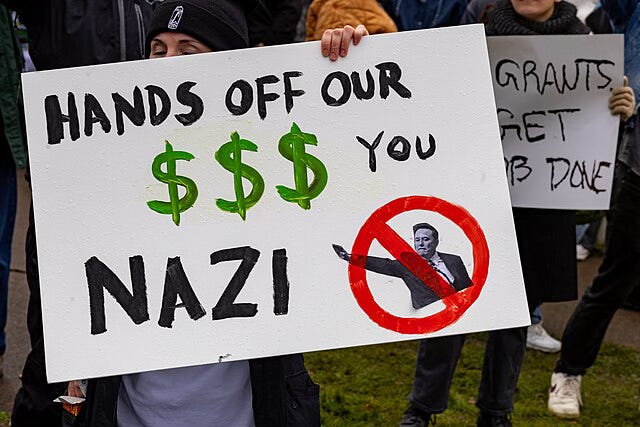
After more than a decade of sales growth, Elon Musk’s most successful company, Tesla, experienced its first-ever annual sales decline last year. Although the drop of just over 1 percent may seem small, the fact that Tesla grew sales by 38 percent the previous year should raise concerns for shareholders and investors, many of whom are banking on strong future growth.
With Musk’s acquisition of Twitter/X in 2022, his full endorsement of President Trump in 2024, and his recent moves through DOGE within the federal government this year, people have become more aware of Musk’s ambitions—and much less supportive. This shift in awareness occurred because Americans realize it is one thing to take huge risks on yourself with your own money and business, but quite another to gamble with others' money and businesses as collateral.
If Musk isn’t careful, his political antics through DOGE, and his rants in the Oval Office and on X, will negatively impact his businesses in the long run.
Move fast. Break things. Rarely correct.
Twitter/X is a clear example of how Musk's personality and public statements can negatively impact revenue and demand for his businesses. When the billionaire took over the app, it was at its peak—both in usage and revenue. Since then, things have deteriorated: investors and advertisers have dropped out, subscriptions aren't selling, claims of shadow banning continue (including one involving the mother of his child), and bots dominate reply sections.
For my part, X has become almost essential as a writer and political analyst. While I enjoy doom-scrolling and replying to my favorite writers, the amount of garbage on the For You page, as Sam Harris claims as the catalyst for his self-removal, is undeniable. I'm a real fan of Musk's business ventures, but not his politics. In fact, his politics are so off-putting, that they’ve even influenced me to shun his products: canceling my premium subscription on X and less willing to purchase a Tesla in the future.
Slow Boring writer Matthew Yglesias had a really good thread about this phenomena. His general point was that blue states subsidize Tesla because they’re the ones who care about green energy, and people should consider alternative products to Musk’s given the increase in EV competition, especially with Musk becoming one of the most polarizing figures in the world. If people like this—those more likely to purchase EVs and use social media, like young liberals and progressives—start turning away from Musk's politics, it will eventually impact his important companies’ future prospects of clients and investors.

The self and its brain
One of the most important of Musk’s companies in the middle-to-long term is Neuralink: an implant that monitors and stimulates brain activity using electrical currents. The goal with this product is to help people with paralysis communicate by enabling them to control devices remotely with their brains—and much more uses on the horizon. Musk’s other company, Starlink, simply lacks the demand needed to make significant strides in the satellite industry—plus, they have Amazon to compete with on both fronts. Neuralink, on the other hand, is something I could see becoming more widespread in my lifetime, unlike the project of colonizing Mars. However, with Musk becoming increasingly politically charged and unpopular among the public, he is inevitably putting this would-be groundbreaking tool at risk.
Neuralink requires volunteers to agree to implant a chip in their brain—a tough thing to trust anyone with under normal circumstances. It would be nearly impossible, even if I had dementia or a neurological issue, to trust a company whose CEO does Nazi salutes as an act of humbleness. It might be that my dislike for Musk is clouding the distinction between the founder and the product, but I think most understand implanting something in your skull is much more invasive than choosing a car or using a satellite internet service.
This isn’t really new
Tesla and SpaceX largely rely on government subsidies to stay afloat, and I think they’re good enough businesses in a niche enough market to warrant that support. But as Yglesias alluded, the quality of a business can only carry it so far before the person behind it becomes relevant to people’s willingness to engage with it.
We have plenty of examples of this—from conservatives boycotting Bud Light to progressives boycotting Chick-fil-A, largely due to the political views of the owners. I’m not calling for a boycott here, but I’m pointing out the seemingly already-underway trend of Democrats moving away from not just Musk, but also his businesses. The trend against Musk’s companies will certainly gain steam if his boss — President Trump —refuses to address the economic struggles many people felt from the Biden administration.
Musk’s followers, mostly red-pilled libertarians, don’t care about Tesla because they’re promoting clean energy, but because the cars look cool and go fast. His followers aren’t using Starlink or SpaceX. Those who are more open to his businesses—and who have more income, like coastal elite Lefties—will be the ones he loses out on if he continues his political trajectory. And for significant endeavors, like Neuralink’s implants, he will require a good amount of trust from customers.
If moderate liberals aren’t willing to buy a Tesla or pay $11 for a premium subscription all because of the owner's dreadful politics, then what makes anyone think they will be willing to implant ourselves or hop on his rocket ship using his products? Worst case scenario, in the future, it may be that stepping out of your Tesla or signing up for SpaceX’s Mars trip will be akin to putting on a red MAGA hat. It could also turn out that his businesses simply lack the growth it once had before he became Trump’s right-hand man. In either case, Musk will have made the worst business decision possible.