
Leftists have no choice but to Vote Blue No Matter Who
One slogan for two competing factions

The phrase “vote blue no matter who” takes on different meanings depending on which blue faction utters and interprets it, causing intra-party conflict over who the phrase is actually obligating and to what end.
Leftists have long understood the slogan as moderates imposing partisan obedience. And to leftists’ credit, it is a demand for obedience—but it’s a demand they impose upon themselves.
If one’s goal within the political system is to assert accountability over those who govern, broad coalitions can dissent enough to force their removal. If it’s to dissent enough to force removal and insist the replacement be the specific kind of governance a given faction prefers, dissent through “voting blue” won’t necessarily achieve those goals—particularly if you have little concern for the “who”.
“Vote blue no matter who” works as a strategy because it asks for accountability while sounding, to anyone who wants progressive governance, like it’s promising them that outcome too.
It’s that interpretive gap that causes more factional infighting within the Democratic coalition.
The moderate version of the phrase “vote blue no matter who” can be simplified to “vote for liberalism, democracy, and accountability—despite character or partisan flaws—because it’s been abandoned by MAGA Republicans.”
For leftists, the phrase has meant: “vote for the Democrat no matter how far-right they are, in service of reforms neither the slogan nor vote can ensure”. The leftist interpretation lends confirmation to the cynical idea of an establishment scheme in keeping leftists content in their inability to enforce progressive change.
Moderates don’t feel that same bind because they’re prioritizing holding accountable those who threaten the institutions that make accountability possible in the first place. If they don’t get a progressive agenda, at least those principles are intact and they can try again.
The ambiguity of the message behind “vote blue no matter who” is distributed cleanly along these factional lines.
In a plurality system, a big-tent coalition wins by capturing the median voter. The closer a faction sits to the center, the more its preferences overlap with the winning coalition, and the less it has to compromise. That also means those moderates more often find common priorities with other dissenters, despite party affiliation.
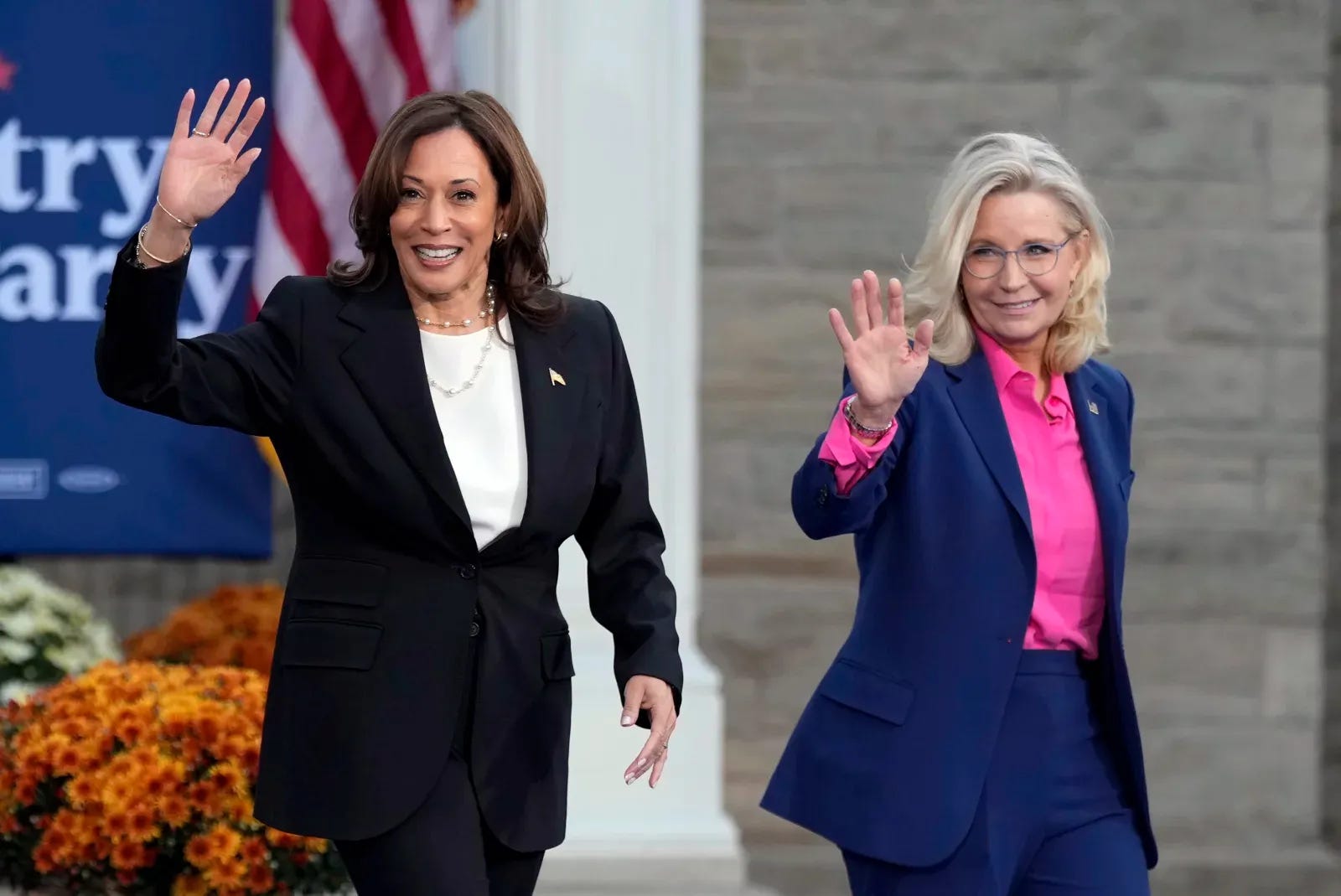
Liz Cheney stumped for Kamala Harris on the shared ground of defending liberal-democratic guardrails against an authoritarian movement. For Leftists, there’s no equivalent option to defect toward when the Democrat on offer disappoints them; they’re structurally constrained because there’s nowhere else to put the vote to good use in light of their stated ends.
That’s also where the perception of moderates’ hypocrisy comes from, and it deserves to be taken seriously.
Moderates calling Cheney an ally while calling Abdul El-Sayed or Zohran Mamdani a liability looks like a redrawing of what’s electorally tolerable to fit factional convenience. But even a fair test can result in Cheney and El-Sayed landing in different spots—for reasons that have nothing to do with party.
The hypocrisy charge from leftists only holds if you accept that “vote blue no matter who” has one fixed meaning that applies equally to everyone saying it. If you think defending liberal democracy in the MAGA-era is secondary to what’s happening with Israel, or ending private health insurance, or abolishing ICE and Thanksgiving, a slogan built entirely around defending liberal traditions will always look like moderates protecting themselves.
In a scenario where Liz Cheney goes against Donald Trump, nearly every moderate Democrat votes for Cheney. Leftists would be more likely to stay home. The irony being that leftists fear the Republican more than moderates do, and in the event their disapproval doesn’t translate into votes for “blue”, a worse outcome wins by default.
Meaning “vote blue no matter who” is more of an electoral strategy for moderates, but an existential necessity for leftists.
Republicans aren’t inherently evil, and moderate Democrats can picture themselves voting for a more liberal version of that party, because many of them already have. Leftists don’t have that picture available to them. Their choice is narrower: support the Democrat, or get something worse. There’s real sympathy owed to the toll that takes: the cycle of distrust, disappointment, and despair that tends to further radicalize.
But sympathy doesn’t solve the problem.
Changing a system, let alone competing within one, requires participating in it. And for the foreseeable future, “vote blue no matter who” will fall most literally on the group furthest from the center—because for everyone else, there are simply more opportunities for the outcome to go their way.