
How Popper freed me from the spell of Plato
The gerrymander I almost defended

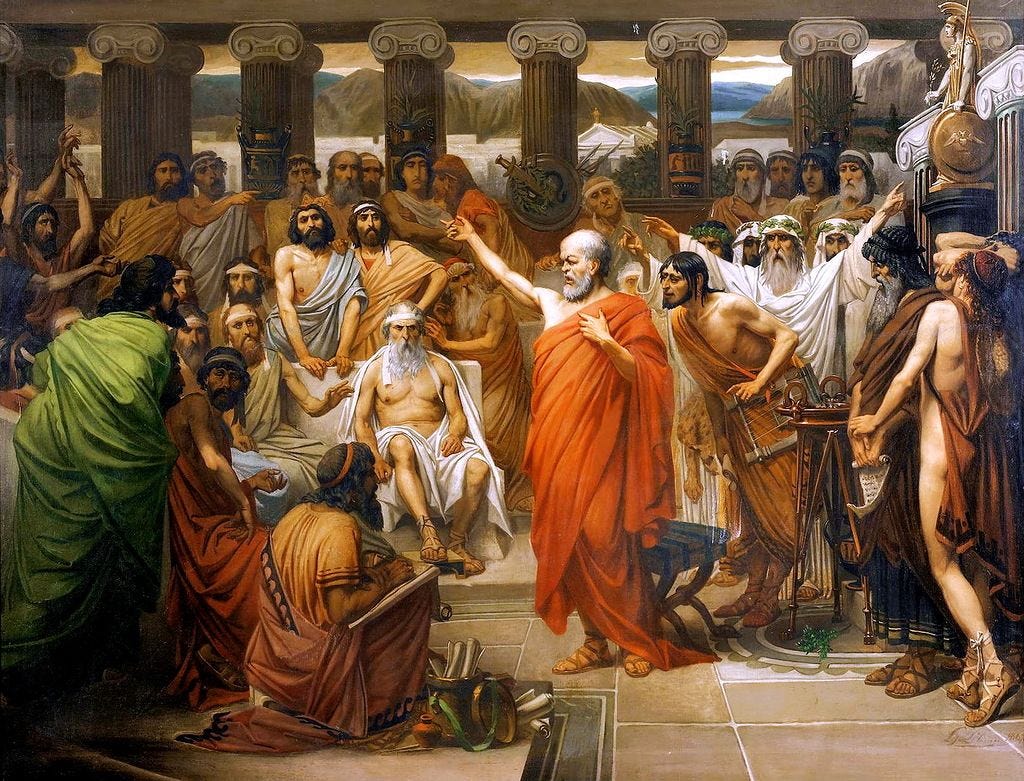
From Plato to Marx, political theorists have contemplated ways in which to establish a suitable answer to the question of who should rule.
It was Sir Karl Popper who offered a refutation to this erroneous way of assessing political systems. He argued that democracy isn’t about choosing rulers but rather how we remove rulers without violence. Democratic systems aren’t meant to find the right leader. As Popper explains, they ought to be designed to survive the wrong ones. We mustn’t die; our theories, our policies, our rulers can fail in our stead. That is—so long as we build systems capable of recognizing failure and replacing what produced it.
Though I explicitly accepted Popper’s theory of error correction, it was nevertheless difficult to grasp when applying it to current political issues like partisan gerrymandering. Since the ruling of the Voting Rights Act, Southern states have begun redistricting their congressional seats to obtain a partisan advantage to the maximal degree. And while our gut reaction to such measures is disdain, I wanted to figure out specifically how it affects the functions of democracy following Popper’s principles of recognizing failure and acting on it.
Working that out took me somewhere I didn’t expect.
The various gerrymandering schemes
One of the things I learned from writing the last piece was how important it is that responsibility is clean. Who to blame should be as clear as possible so that when people want to hold someone accountable, they actually can.
The other thing that stuck with me was removability. The ability to remove those in power is the most fundamental property of a healthy democratic system.
This made me consider competitiveness as the goal. The more competitive the electoral environment, the more susceptible those in power are to removal—even if they won the last election comfortably.
With those two principles in mind, I started thinking about gerrymandering differently. What if maximizing entrenchment by spreading a party as widely as possible across the map actually heightened responsibility? What if you could do this while keeping the removal function as competitive as possible? The more of the government they occupied, the more of the outcomes they owned; and the thinner their margins, the more vulnerable they remained.
That line of thinking led me somewhere counterintuitive: partisan gerrymandering was actually a good thing.
A party that gerrymanders places itself in more districts, giving more exposure, leaving them more vulnerable to removal all while enhancing accountability.
Some gerrymandering techniques allow a sufficiently large swing toward the opposition to flip a greater number of seats compared to others. Virginia’s recent scheme was the proof: Democrats took their votes and spread them thinly across the state. Northern VA Democrats were now more susceptible to removal because they lost votes in safe areas while making disfavored areas more competitive.
Two birds, one stone.
The conclusion seemed obvious: the party in power ought to gerrymander aggressively with the aim of maximizing their responsibility in governance and the competitiveness of each district.
That’s when I encountered Matthew Yglesias’ pragmatic take on gerrymandering using Florida’s efforts as an example.
He argued Democrats’ gerrymandering in Virginia had been self-defeating because they drew maps so aggressive (based on a dominant election) that they left the ruling party overextended.

He thinks gerrymandered maps should distribute voters efficiently across districts to maximize seats in a roughly neutral political environment; in the event of a swing back to the opposition, you retain as many seats as possible.
Florida Republicans did exactly that by drawing more consolidated maps based on voter trends rather than a single dominant cycle.
On purely tactical terms, Yglesias is right. If one party gerrymanders (Republicans) while the other (Democrats) sticks to non-partisan districting, the one with the principle will lose (Democrats). But taken more fundamentally, the Yglesias argument points in exactly the wrong direction from Popper.
Validation!
My theory of an aggressive, thin-margined map that genuinely flips seats under swinging conditions—like in the case of Virginia’s—was indirectly affirmed by Ygleisas’ take on pragmatic partisan engineering in Florida.
I was a step closer to understanding how some partisan gerrymanders stray from the principles of responsibility and removability more than others.
Now all I needed was a way to measure it.
The idol of certainty
Developing a formal model to measure responsibility and competitiveness was difficult. If what I intended to measure was a systems ability of levying responsibility whilst enacting competitive removal processes, what I needed to do was find a way to judge a maps’ dynamism.
I got to something that looked like this: if the goal was to make the maps more competitive, then the variable had to be how votes are spread or wasted across districts. A party sitting on a massive surplus in a safe seat is leaving removal potential on the table. Shave those wasted votes off and redistribute them into less favorable districts and you’ve made yourself more vulnerable while also making more of the map genuinely competitive. Do the opposite by consolidating your support into fewer, safer districts based on demographic trends and you’ve insulated yourself from criticism while entrenching your own power.
A party that deliberately thins its own safe seats to create more genuinely competitive ones is—in theory—making the removal mechanism more sensitive to public criticism across the entire landscape.
Which is exactly what I thought necessary to fulfill the Popperian principle.
What I didn’t realize was that this measurement system already exists. And it doesn’t imply what I had thought.
The learning curve
Nicholas Stephanopoulos developed the theorem for what courts call the “Efficiency Gap”: how wasted votes are spread to give the ruling party a partisan advantage.
When I found it I again felt briefly vindicated: it measures partisan asymmetry in vote translation, which is exactly what I’d been circling.
But I had conflated two things that are actually separate. And I was wrong about both.
First: there’s a difference between how a party distributes surplus votes across districts and how vulnerable it is. I was wrong in thinking that minimizing wasted votes necessarily produces more competitive districts. It doesn’t.
The efficiency gap measures partisan bias, not competitiveness. A map can be perfectly balanced by each party wasting roughly equal votes while still being full of safe, uncompetitive districts where neither side faces any real removal pressure. Just because both parties happen to be wasting votes “equally” doesn’t make it competitive. And a map with a significant efficiency gap can still contain genuinely competitive districts where criticism finds purchase and removal is cost-efficient.
For instance, imagine a ten-district map where five districts are drawn so Democrats win 70-30, and five are drawn so Republicans win 70-30. Each party wastes roughly the same number of votes. The efficiency gap is near zero. But dynamism is near zero too—criticism has almost nowhere to find purchase, and removing the governing party requires a swing so large it would have to flip districts where they're winning by twenty points or more.
Second: I was wrong in presuming one should be trying to determine a specific outcome at all. Even if you can measure how vulnerable rulers are by assessing how they distributed surplus votes, that's still engineering inputs to produce competitive districts: deciding the right proportions each input should possess.
But the Popperian standard is about whether the system can correct itself when outcomes are bad. I was asking whether wasted votes are being distributed to make areas artificially competitive where they were not. It was an attempt to determine outcomes fairly. It was a moment of deciding the right proportions each input should possess.
It was then I fully realized I was still asking the wrong question.
Who should rule? How can we blame and remove rulers?
I had been trying to measure something about how well the system corrects itself; and accidentally reconstructed a tool for measuring whether the correction was being distributed evenly. Those are not the same question!
The efficiency gap and the ‘greedy gerrymander’ fail for related but distinct reasons, and that’s how I realized I was conflating them. One misfires the removal signal, the other corrupts the governance that makes removal meaningful.
The electoral problem appears when artificially thin margins causes a party to lose because the map made them structurally fragile.
The governing problem is subtler: rulers on razor-thin margins govern more like hostages than the natural majority.
A safe seat produced by non-partisan principles (compactness, contiguity, genuine community boundaries and support) is genuinely safe because the underlying political geography actually produces that result. The majority knows they have a real mandate, rather than one they made for themselves. A party that governs boldly from that kind of safety and fails deserves to lose it, and the system is structured so that they will.
It was only once I recognized my errors that Plato's spell was—hopefully—lifted. And it’s when I finally conceded that non-partisan, single-member plurality systems preserve the causal link between governing badly and being removed better than any alternatives.
Gerrymandered maps corrupt it no matter whether they manufacture safety or manufacture vulnerability. That was the missing piece of Popper’s principle. Not about how to manufacture maps to make the most places the most competitive, but in upholding the translation of natural shifts in the electorate into a governing body who understands their constraints—or lack thereof.
A mandate is earned through genuine geography, persuasion, and ultimately, failure. And it’s why the representation instinct, however well-intentioned, keeps producing the wrong solution. Independent commissions drawing maps to ensure proportional outcomes, as many people prescribe, are still asking who should get a say, and by how much.
But we should want a system where wrong answers die quickly and where the people responsible for them can’t insulate themselves from that verdict. That’s what Popper meant. That’s what gerrymandering, at its worst, prevents and at its best, dilutes.
For a second there I thought you were actually saying gerrymandering was a good thing! Whew! I do understand how it went wrong, but at least you found it out and could track the logic!
I first saw the efficiency gap in college, it was being used in one of the Wisconsin gerrymandering cases. This is the first time I've read about it since, which is strange given everything that's been happening lately. Whatever the efficiency is I think we need to get rid of gerrymandering altogether for the sake of principle.