
Five overlooked stories about America's Founding Fathers
Happy 249th, America!

George Washington

Washington is quite known for his warnings of partisanship from his farewell address in 1796:
[Parties] serve to organize faction, to give it an artificial and extraordinary force—to put in the place of the delegated will of the nation…
However, combinations or associations of the above description may now and then answer popular ends, they are likely, in the course of time and things, to become potent engines by which cunning, ambitious, and unprincipled men will be enabled to subvert the power of the people and to usurp for themselves the reins of government, destroying afterwards the very engines which have lifted them to unjust dominion.
At the beginning of his presidency, Washington genuinely tried to live up to the nonpartisan ideal the other Founders had hoped he would embody. He made a point of hearing both emerging factions: the Hamiltonian Federalists and the Jeffersonian Republicans. In fact, he appointed both Hamilton and Jefferson to his first-term Cabinet. And despite decisions that invited controversy—such as his neutrality in the wars between Britain and France, and his forceful suppression of the Whiskey Rebellion—Washington still managed, for a time, to maintain credibility across party lines.
But that balance didn't last.
Washington strongly supported the Constitution and the centralized authority it established. His close relationship with Hamilton and his embrace of initiatives like the Jay Treaty only deepened his association with the party. By 1792, when he reluctantly agreed to serve a second term, Washington was already lamenting the “internal dissentions” that, in his words, made it hard to “manage the reins of government or to keep the parts of it together.”
His optimism began to fade, and at one point, he even warned Jefferson that the republic was in danger of unraveling from within.
By his second term, Washington’s outlook had grown increasingly bleak. Republican figures like Jefferson and Edmund Randolph didn’t last through the Admin. Washington came to view the Republicans as disloyal, especially because of their outspoken support for Revolutionary France. Republican-aligned newspapers began to attack him personally and viciously, which left him embittered.
By 1798, near the end of Washington’s second term, the divide had fully hardened. When President John Adams asked Washington to return to public service as Commander of the Provisional Army during the Quasi-War with France, he agreed, but only on the condition that Hamilton serve as his second-in-command. Washington also insisted that Republicans be excluded from officer appointments. He personally vetted officer lists and rejected any candidates he suspected of Republican or pro-French sympathies.
In his letters from this period, Washington expressed clear partisanship and mistrust of the Republican faction, even referring to some of its members as “traitorous.”
Thomas Jefferson and John Adams
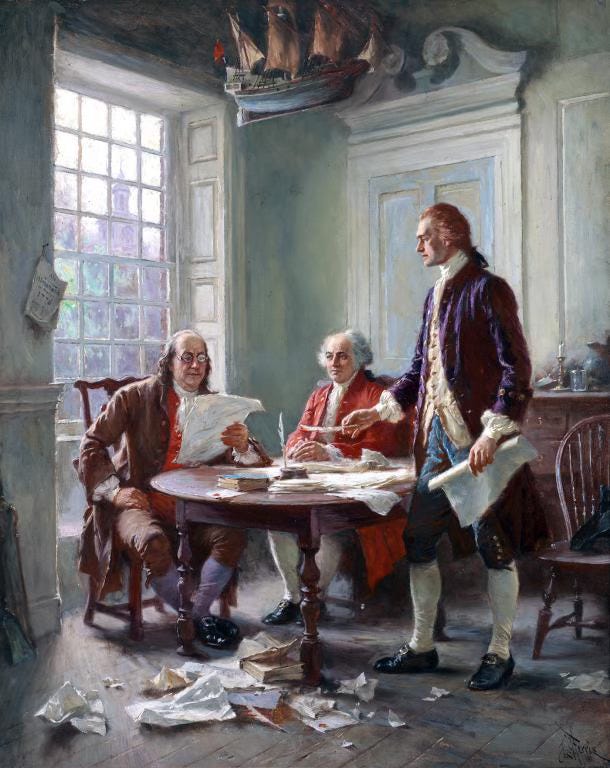
Jefferson and Adams had a tumultuous relationship. They first met at the Second Continental Congress, where Adams was already a well-known and outspoken delegate from Massachusetts, while Jefferson was the younger delegate from Virginia. Adams was immediately impressed by Jefferson’s talents—especially his writing ability—and they developed a mutual respect.
On June 11, 1776, Congress appointed Jefferson to the committee tasked with drafting a formal Declaration of Independence. His fellow committee members—Benjamin Franklin, John Adams, Robert Livingston, and Roger Sherman—agreed that Jefferson should write the first draft.
Years later, John Adams recalled insisting that Jefferson take on the task:
Reason first—You are a Virginian, and a Virginian ought to appear at the head of this business. Reason second—I am obnoxious, suspected, and unpopular. You are very much otherwise. Reason third—you can write ten times better than I can.
In the 1780s, both served as diplomats in Europe—Adams in London and Jefferson in Paris. Though both had missed the Constitutional Convention of 1787, they approved of the new government system, albeit with some differing reservations.
However, just as Washington became a target of fierce early partisanship—much more intense than today—Adams aligned with the Federalist vision: a strong central government and close ties to Britain. Jefferson led the Democratic-Republicans, advocating for states’ rights and support for Revolutionary France.
By 1796, they represented opposing factions, with Adams ultimately winning the presidency. Jefferson became Vice President due to the electoral system of the time, which awarded second place the vice presidency. Their working relationship quickly deteriorated.
Jefferson opposed much of Adams’s agenda from within the Admin, and with the Republicans controlling the House for most of Adams’s term, Adams faced major legislative opposition. One of Adams’s most controversial moves was his support for the Alien and Sedition Acts in 1798. The Sedition Act especially targeted Republican newspapers and politicians, including Jefferson’s allies, widening the rift between the two founding friends.
Jefferson, with James Madison, secretly authored the Kentucky and Virginia Resolutions, condemning those laws and hinting at the doctrine of nullification. Both sides accused each other of conspiring to undermine the republic—another common charge during that era.
The bitter election of 1800 sealed their estrangement. Jefferson defeated Adams after one of the nastiest campaigns in U.S. history. In his bitter defeat, Adams refused to attend Jefferson’s inauguration—the only president besides his son John Quincy Adams in the late 1820s, and Donald Trump two centuries later, to do so. The two founding friends ceased all communication for over a decade.
In 1812, their mutual friend Dr. Benjamin Rush helped revive their friendship. They began a remarkable correspondence—over 150 letters—discussing philosophy, religion, politics, aging, and the Revolution in one of the most treasured exchanges in American history. Both retired from public life and lived at their respective estates. In 1824, Jefferson sent Adams a letter congratulating him on his son’s rise to the presidency.
Adams had reached out first in 1812, writing to Jefferson: “It would be a cruel omission on our part to leave this world without declaring to you our sincere affection and esteem.”
They maintained this friendly correspondence for the next decade and a half, until their deaths. But there’s more: both Adams and Jefferson died on the same day—July 4, 1826—exactly 50 years after they had collaborated on the Declaration of Independence.
Adams’s rumored last words were, “Jefferson still lives,” encapsulating one of the most intense, volatile, and intellectually rich relationships of any two American statesmen.
The Three-Fifths Compromise
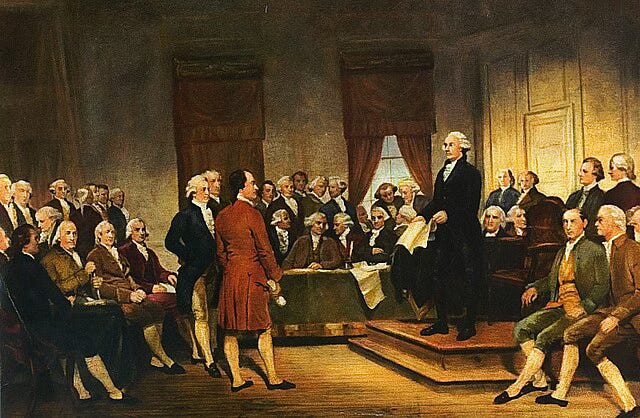

The Three-Fifths Compromise, forged during the 1787 United States Constitutional Convention, is one of the most controversial and paradoxical aspects of the early American political system.
The agreement addressed the issue of how enslaved people would be counted in a state's population for purposes of representation in Congress, electoral votes, and taxation—ultimately granting Southern states disproportionate power in the federal government.
For Southern states, where slavery was a cornerstone of the economy, counting enslaved people toward their population was crucial. However, these enslaved people had no rights and could not vote. Northern states opposed this, arguing that if slaves could not vote, they should not be counted for purposes of representation. The compromise also had implications for taxation: the same three-fifths ratio applied to the apportionment of federal taxes, which reduced the tax burden on slaveholding states.
The arguments surrounding the Three-Fifths Compromise were steeped in contradiction: Southern states, despite recognizing enslaved people as property, insisted slaves count as full persons when it came to gaining political power and taxation—giving them more power over the North. Northern delegates, on the other hand, wanted only free people to be counted for representation, arguing that only those who had voting rights should be counted. However, they also wanted slaves to be counted as property for the aims of taxation in the South.
Each side held a contradictory position that also contradicted the other side’s arguments: wanting slaves to be counted as full people and property to their benefit.
The Three-Fifths Compromise, chiefly created by James Madison, enabled Southern states to wield greater influence in Congress, the Electoral College, and the presidency. For instance, by the 1790 census, the South had 47 of the 105 seats in the House, a number that would have been significantly reduced had slaves not been partially counted. Historians have also speculated that without the additional slave state votes, Jefferson would have lost the presidential election of 1800, slavery would have been excluded from Missouri, Jackson's Indian removal policy would have failed.
The U.S. Constitution initially allowed the importation of enslaved people for 20 years. Denmark was the first nation to abolish its trade in 1803. Britain and the United States followed in 1807, with the U.S. ban going into effect in 1808 under Thomas Jefferson. It is also important to note that the words "slave" and "slavery" do not appear in the original U.S. Constitution, and instead, enslaved individuals were referred to as "other Persons."
Alexander Hamilton and Richard Burr
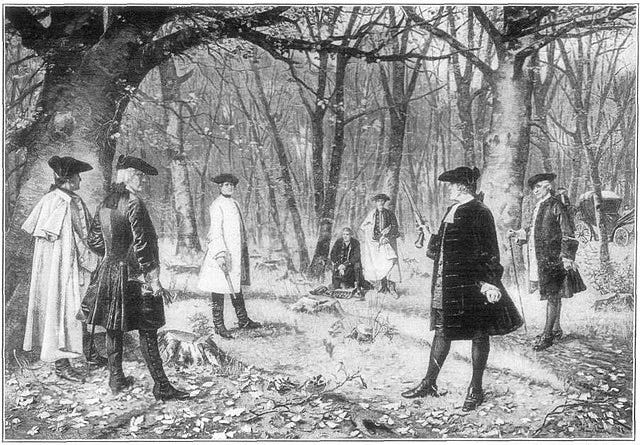

The Hamilton-Burr duel marked the final confrontation in a long-standing rivalry between the Republicans and the Federalists. This conflict began in 1791 when Aaron Burr won a United States Senate seat, defeating Hamilton’s father-in-law and a staunch Federalist supporter. At the time, Hamilton served as the U.S. Secretary of the Treasury.
The rivalry intensified during the 1800 presidential election when the Electoral College deadlocked, and Hamilton’s influence in the House of Representatives helped secure Jefferson’s victory over Burr.
Burr and Hamilton first clashed publicly during the 1800 presidential election when Burr and Jefferson ran together against incumbent President John Adams. Throughout Jefferson’s presidency, the two continued their rivalry through published editorials—often under pseudonyms—that publicly criticized one another.
Eventually, Burr issued a formal challenge to Hamilton, which Hamilton accepted. Some historians suggest that Burr sought to restore his honor by challenging Hamilton, whom he regarded as the only gentleman among his critics, particularly in response to the damaging attacks on his character during the 1804 New York gubernatorial campaign. Both men had prior experience with dueling—Hamilton having participated in more than a dozen affairs of honor, including duels with James Monroe and George Clinton.
Although Hamilton ostensibly did not wish to proceed with the duel, he felt compelled to honor the challenge because of his previous attacks on Burr and Burr’s conduct leading up to the duel. Hamilton wrestled with reconciling his moral and religious beliefs with the prevailing codes of honor and political necessity. Some historians speculate that Hamilton intended to accept the duel but deliberately “throw away his shot.”
The duel took place on the banks of the Hudson River in New Jersey. Burr shot Hamilton in the abdomen, while Hamilton fired into the air, hitting a tree branch behind Burr. Hamilton was transported to New York City for medical treatment but died the following day.
But the story didn’t end there:
Following the duel, Burr did not immediately return to his official duties. The incident sparked a massive scandal, and several Northern states, including New York and New Jersey, issued warrants for his arrest on charges ranging from murder to manslaughter. Burr fled the area and avoided returning to New York for some time to evade prosecution. Burr kept a low profile to avoid arrest and, under mounting political pressure and isolation, resigned in early 1805.
Despite these charges, Burr was never formally tried for Hamilton’s death. While dueling was illegal, it remained somewhat socially tolerated within certain circles. However, Burr’s political career was effectively ended by the duel. He spent much of his later life in relative obscurity and controversy, including a later trial for treason in 1807, which was unrelated to the duel or Hamilton’s death.
John Quincy Adams

Not often recognized as a founding father, John Quincy Adams (JQA) was indeed present and influential during America’s founding era. Though much younger than the Washingtons, Jeffersons, Hamiltons, and their peers, he was nevertheless a fierce statesman—and my personal favorite in history—who supported and shaped the administrations and foreign policies of these iconic figures.
JQA was just down the road in 1770 when the Boston Massacre occurred. His father, John Adams, served as the defense lawyer for the British soldiers involved.
Beginning in 1778, JQA frequently traveled to Europe with his father; at age 11, he journeyed to France, where his father was securing French support for the American cause. During his youth and early adulthood, JQA made at least three or four significant transatlantic crossings. Through these travels, he learned several languages by conversing with workers and immigrants. By adulthood, he was fluent or proficient in five or more languages, including French, Dutch, German, Latin, Greek, Spanish, Italian—and possibly Swedish.
In 1794, during Washington’s presidency, JQA was sent as a special envoy to Prussia to negotiate a treaty. This appointment was surprising since John Adams was then Vice President under Washington, yet Adams was unaware of the appointment. Washington’s personal confidence in JQA signaled his extraordinary potential. This mission led to the Treaty of Amity and Commerce with Prussia, the United States’ first formal treaty with a European power following the Revolutionary War.
But that was only the beginning.
Thomas Jefferson appointed JQA as U.S. Minister to Portugal. James Madison sent him as U.S. Minister to Russia during the War of 1812. Later, James Monroe appointed him Secretary of State.
JQA was also nominated to the Supreme Court by President Madison but declined the appointment. Additionally, he influenced one of Jefferson’s most controversial policies—the Embargo Act of 1807—which prohibited American ships from trading in foreign ports. Intended to protect American shipping during the Napoleonic Wars, the embargo ultimately damaged the U.S. economy more than its targets.
To my knowledge, JQA is the only American statesman to have held every major office: diplomat, ambassador, cabinet member, member of the Massachusetts State Legislature, U.S. Senator, U.S. Representative, and President.
Despite his presidency being undermined by Jacksonian Democratic opposition, he later returned to Congress’s House chamber, becoming a fierce opponent of slavery and the infamous Gag Rule. He tirelessly fought for its repeal, believing it violated the right to petition and suppressed vital national debate. Through eloquence and persistence, Adams challenged the rule and submitted numerous anti-slavery petitions. His efforts contributed to the Gag Rule’s repeal in 1844. He remains the only former president elected to the House of Representatives.
JQA began as a Federalist within Jefferson’s Republican administration, became a Whig in the 1830s after losing a bid for Massachusetts Governor, and won the presidency as a National Republican, distinct from the Jacksonian Democratic coalition. His ability to work across factions—except with Andrew Jackson—and his refusal to succumb to pure partisanship made him an independent thinker amid a growing political divide that foreshadowed the Civil War just a generation later.
One of my favorite quotes about JQA came from his father after being rejected by the Federalist Party in 1808:
You are supported by no Party. You have too honest a heart, to independent a Mind and too brilliant Talents, to be Sincerely and confidentially trusted by any Man who is under the Dominion of Party Maxims or Party Feelings,: and where is there another Man who is not?
In 1846, at age 78, JQA suffered a stroke that left him partially paralyzed. He made a full recovery and resumed his congressional duties, and when he entered the House chamber in 1847, the members rose and applauded.
On February 21, 1848, while the House debated honoring U.S. Army officers who served in the Mexican–American War—a war Adams vehemently opposed—he rose to speak, collapsed from a massive cerebral hemorrhage, and died two days later inside the Capitol on February 23.
His final words were, “This is the last of Earth. I am content.” Among those present at his death was Abraham Lincoln, then a freshman representative from Illinois.
Quite fascinating how accepted social norms change over time, the idea of politicians today challenging each other to duels would be quite ridiculous😅
What an entertaining essay!
I am 3/4 through Bordewich's "Bound for Canaan", a history of the politics of the early to mid 1800's in slave America, and the Underground Railway.
It is no wonder that "former" Slave States are at the core of Red States today. The political philosophers who founded the Nation stated a principle but served that principle with expedience, the keystone of America's worst troubles ever since. "3/5 of a person". Indeed.
We see now what Jefferson meant when he did not differentiate when he wrote that we are all equal, and have equal rights as entitlements: equal life, equal liberty, freedom to do what we want if we don't hurt others. One, two, three. If you don't believe in that, you're not an American.
That also means, one person, one vote. Just like the indispensable "3/5" compromise, the Electoral College is an absurdity the time of which has come to dispense with as indefensibly bigoted as denial of voting based on race or gender or property.