
Americans are too concerned with peace
Peace without justice is a kind of slavery

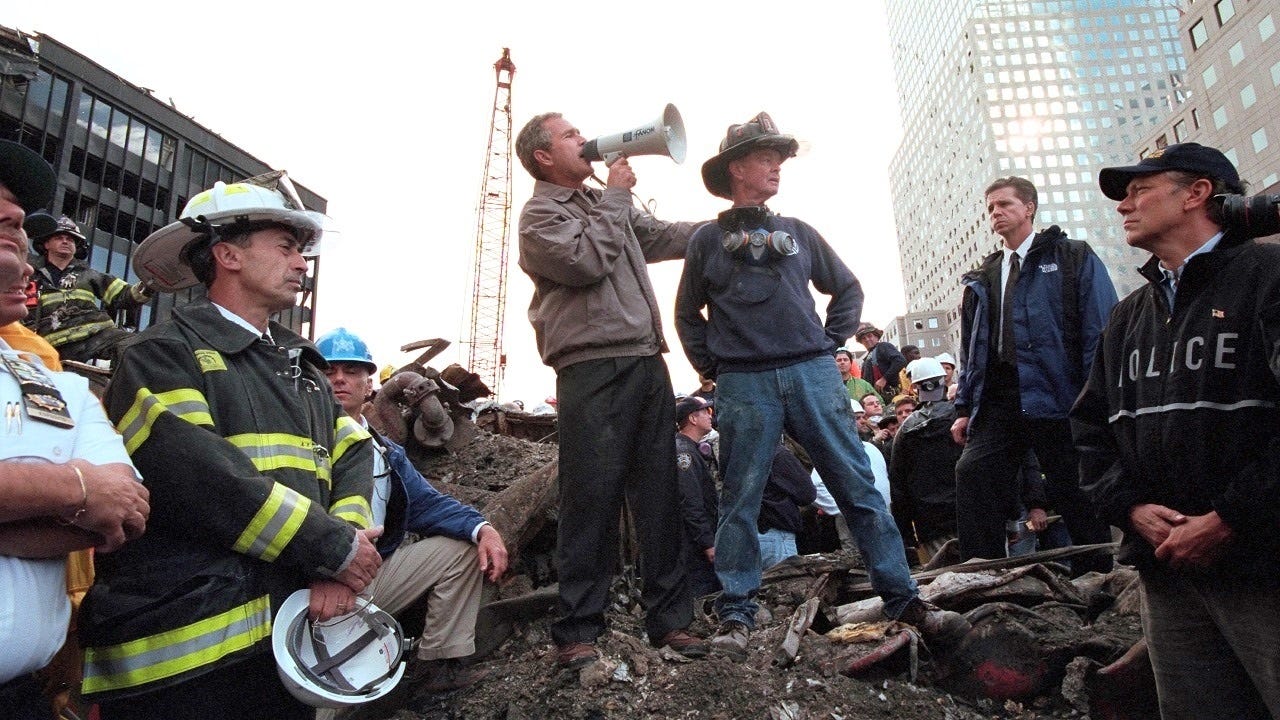
One of my favorite presidential moments in American history is when George W. Bush stood atop the rubble of the World Trade Center with a bullhorn in hand and, with his Southern accent and pointed finger, assured the crowd that the world would hear from us in response to the attacks. Chants of "USA” amplified the true unity and righteousness Americans felt when gripped by uncertainty and fear.
Here’s the clip if you haven’t seen it or don’t remember:
Within a month’s time, the U.S. invaded Afghanistan. And within three, the American-led coalition toppled the Taliban regime. Americans rallied behind decisive action because we thought peace could not be restored without justice. And justice, in that moment, required assertive force.
Running from the past
The moral seriousness of our role as Americans, our values, what evil really looks like—has mostly vanished. In its place, a fragile obsession with peace at any cost has taken hold.
After two decades of ambiguous missions, political deceit, and exhausting counterinsurgencies in Iraq and Afghanistan, Americans now flinch at the very idea of taking assertive action. We have ostensibly surrendered our will to fight for those who want to but cannot fight; to be a force of good in the world. We've mistaken restraint and appeasement for diplomacy. The world is still violent, still unjust, and still in need of leadership rooted in principles, not just fear of entanglement.
When the U.S. invaded Iraq in 2003, Saddam Hussein was framed as an imminent threat. Though much of it was built on exaggerated intelligence and political manipulation, the purpose was clear: to aggressively impose justice, safety, and certainty in the face of the unknown and in an environment of potential, existential danger.
The backlash of the war through the decades has only increased. Americans were angry at being misled and at the cost in lives and dollars. That anger hardened into aversion not just to those wars, but to the idea of war itself.
The broader conflict
The phrase “Forever Wars” became a bipartisan rallying cry, heard multiple times in the Democratic primaries of 2020 and in the GOP in 2024. This generation of Americans equates military action with futility and isolation with virtue. But we’re in a civilizational competition, not just fighting terrorism or rogue states.
Russia is attempting to erase a sovereign democracy from the map. Hamas openly calls for the extinction of Israel—and the West. China threatens Taiwan on a monthly basis. Iran funds proxy militias that murder civilians and destabilize entire regions. And in the face of this, Americans are tuning out.
Both the left and the right make ridiculous signals of appeasement by declaring, “Too many people are dying; We need peace; We can’t police the world; We have problems at home; and Diplomacy is the answer,” in the face of threats to our society.
And who could disagree that peace is desirable? But the problem is peace does not equate to justice. Peace can be achieved through surrender, letting evil win, and silence in the face of atrocity. The people calling for peace today rarely ask what kind of peace they're talking about—or what price they’re willing to pay to get it. Americans now judge every conflict by how cleanly it can be ended, not by who is right or wrong. They judge them by the casualty count instead of moral arguments. As a result, we’ve developed an allergy to making moral distinctions.
The costs of peace
The enemies we fought in Iraq and Afghanistan were adversaries of liberal democracy, free expression, the rule of law—open societies. They despise our fundamental mechanism for sustaining change without violence. They seek despotism and control, not egalitarian individualism.
Most Americans' first reaction today is to bring up the financial costs of joining efforts to secure justice. But America literally cannot afford moral ambiguity. We don’t have to put boots on the ground everywhere. But we do have to be clear about who we support, and why.

When we hesitate to fund Ukraine or question Israel’s initial defense without acknowledging Russian aggression or Hamas’ barbarism, we show not moral wisdom, but moral blindness. This is not to excuse the irrational ideas on either side. It is a recognition that morality exists and rarely, if ever, do both sides offer a perfect balance of character nor aggression.
Some ideas are objectively better than others; we should work to improve the situation, not cower on our side of the pond.
Have some pride
What frustrates me most is that we are still the most powerful nation on Earth but hardly anyone acts like it. We have the most advanced military, great alliances, and a set of values that have fostered much of our success, especially when we live by them. Yet too many of my fellow Americans see this power as a burden rather than a gift. They act as if defending allies means abandoning ourselves. They fall for the false dichotomy: either we help Americans or we help the world.
As former Vice President Mike Pence rightly put it in a 2023 interview with Tucker Carlson during a summit in Iowa: “Anybody that says that we can’t be the leader of the free world and solve our problems at home has a pretty small view of the greatest nation on earth.”
It’s not a matter of resources—it’s a matter of will. We should’ve lost the American Revolution; it was a matter of persistence, strategy, and a desire for justice that we won. We don’t need to relive the Bush years—we don’t need another Iraq. But we do need the moral confidence of that bullhorn moment, where justice, not trauma, defined our purpose.
We must stop treating peace as an end in itself. If we don’t stand for justice abroad, we may find ourselves too delayed and divided to defend it at home.