
Alexander Hamilton would be disgusted at Trump's tariff policy
The Founders thought about policy in light of their goals. Trump should do that too.

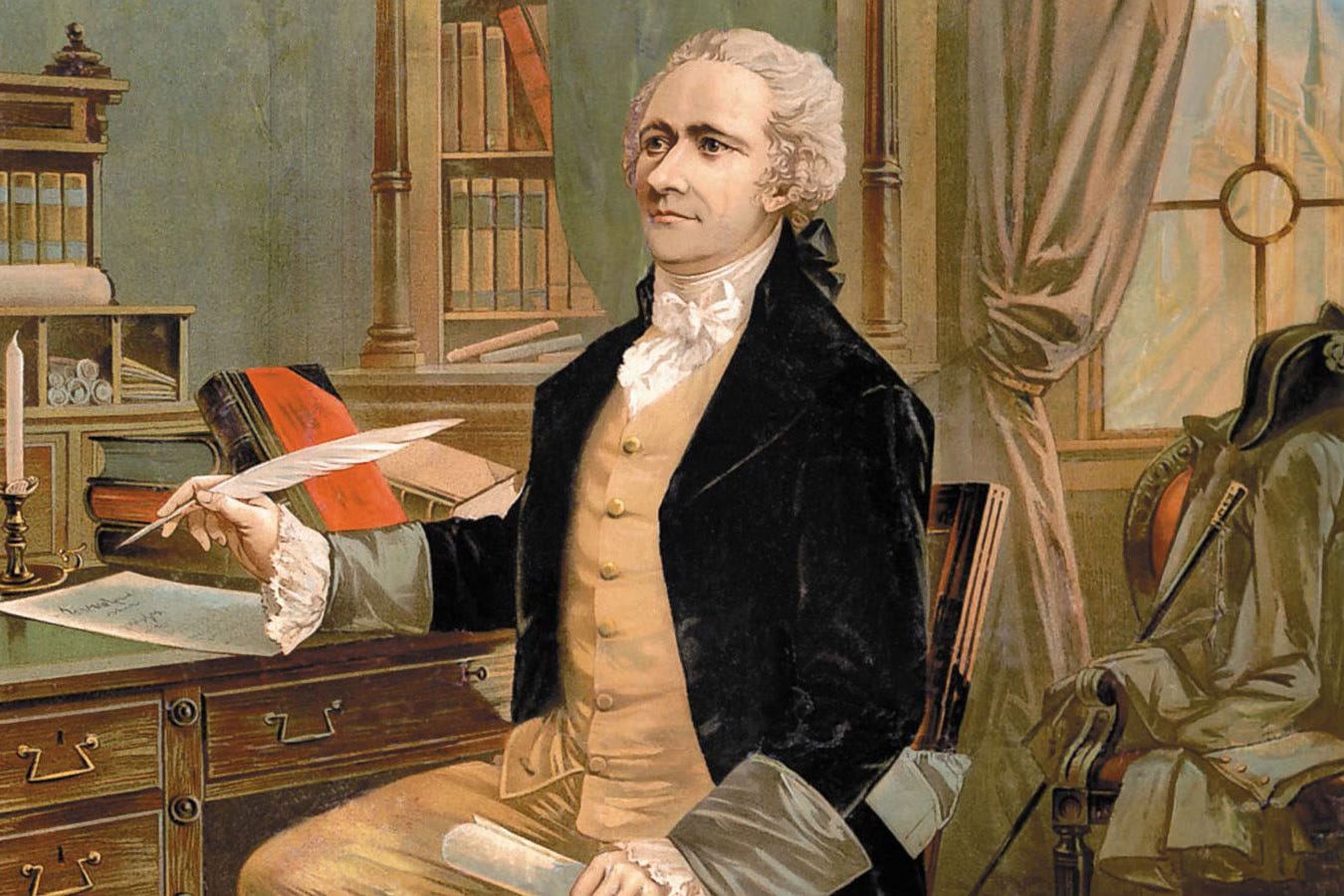

As early as the 1780s, the Founding generation was already locked in arguments over trade, taxation, and economic independence. These early debates were often as much about generating revenue as they were about identity and ideology.
The Founders had thought-out reasons for their actions; and they took the political, economic, and institutional realities of their time into heavy account.
As the Trump Admin attempts to go back in time with its tariff policies, I thought it insightful to revisit what exactly the Founders were arguing at the time.
One of the main distinctions I noticed between the current Admin and early American figures was a coherent purpose—or lack thereof.
The circumstances we’re facing today do not mirror those from 200 years prior. And thus the reasons we impose tariffs today should look very different from the motivations Alexander Hamilton or James Madison had in mind.
Those differences in context matter just as much as the theories—the proposed solutions to specific problems—themselves!
21st century policy with 18th century arguments
There’s a common saying: Those who don’t know history are doomed to repeat it.
That’s too much of a historicist view of civilizational development for me, so I cannot say I agree. But I do think that understanding history can help offer clarity. By looking at the Founders’ thinking, we can maybe improve how we contemplate tariffs altogether.
My own curiosity on this was sparked by Treasury Secretary Scott Bessent, in which he claimed Alexander Hamilton used tariffs to raise revenue and boost American industry—and that Trump is just following the same path.
That’s not entirely wrong. But it simplifies a complicated picture.
And again, things have changed; so our purpose, our reasons for using tariffs, and the goals we aim to achieve should change with it (and optimistically, in an improved fashion).

Taxing poor people in poor states
Unfortunately for us Americans, it’s clear Hamilton had a far more sophisticated grasp of tariff policy than Bessent or Trump.
One reason for this hunch is that the talking points Bessent rattled off don’t actually explain much about the current Admin’s trade policy:
A big problem with the Trump Admin is that it rarely provides a clear rationale for what it does. And worse, it offers outdated reasoning—justifying 21st-century policies with 18th-century logic.
Hamilton faced a radically different set of challenges in a time when Congress couldn’t reliably raise tax revenue. Under the Articles of Confederation, there was no reliable way to fund the national government. Hamilton saw tariffs as a tool for protectionist maneuvers, but only because it was sufficient in filling the spot of practical methods to fund an emerging federal state.
Nevertheless, Hamilton understood the pitfalls of hastily raising taxes on imports even with the nation’s lack of revenue.
In Federalist No. 35, Hamilton explained that when merchants pay taxes on imported goods, those costs are often passed onto consumers in importing states—creating unequal burdens between states with different economic profiles and households with varying resources.
Today, the situation is different. Yet, the Trump tariffs raise similar fundamental problems.
Though Congress now has all the authority it needs to procure taxation, states like California—with large, diverse economies—can better absorb high tariffs during the Trump Admin. Others, especially red states like Kentucky, Indiana, and Tennessee, suffer disproportionately. These states rely more heavily on imports relative to their GDP and smaller economies.

Additionally, because California’s economic activity is so much higher, they often provide much of the federal subsidies to poorer neighboring states. The tariffs are still effecting California though, which means not only will those poorer states feel more impact from tariffs, but also that provider states like California will be in a worse position to support their neighbors.
Tariffs are regressive: they disproportionately hurt lower-income households that spend more of their income on consumer goods. And these same households are often concentrated in the states most exposed to tariff burdens.

Lower-income households spend a larger proportion of their income on goods and services, and higher rate tariffs often apply to lower-end goods, not luxury items.
Hamilton noticed these problems when theorizing over 200 years ago. When will the Trump Admin notice?
Protectionism through favoritism
Hamilton acknowledged that high import taxes can force industries to change in unproductive ways: merchants might end up shouldering the costs themselves if consumer demand can’t support higher prices.
Though today small businesses have more resources and support than those in Hamilton’s time, they still operate with razor-thin margins—only becoming profitable after two to three years. If those start-up years are spent paying steep tariffs, while still needing to keep prices low to attract customers, their survival becomes much harder.
The U.S. Chamber of Commerce reported that small-business importers (those with fewer than 500 employees) brought in $868 billion worth of goods in 2023. Under Trump’s duties, the collective annual tariff burden on these businesses now tops $202 billion—around $856,000 per firm per year.
Right now, many businesses are eating those costs. But eventually companies will seek profit—or preferential exemptions.
Crony capitalism
High protectionist trade policies were first proposed in 1824 when Senator Henry Clay of Kentucky gave a speech arguing that tariffs offer lucrative benefits to recipient industries, allowing them to sell their goods at higher prices than under foreign competition. With protective rates on the table, the tariff issue gave rise to the lobbying establishment in DC: industry representatives flooded the body with requests for preferential rates. Backroom deals were cut and bribes changed hands on committee floors.
Although Clay packaged his scheme as a strategic and finely tuned economic program, its practical reality turned into a free-for-all of public graft (we can already start to see the same problems with the current Admin.)
It’s possible Trump is doing an inverse theory of tariffs where instead of targeted taxes on imports of specific industries or products for particular national security or industrial reasons, he’s putting tariffs on everyone and everything, then exempting the things he thinks deserving—or to whoever grovels the most. Crony capitalism.
According to Advancing American Freedom Foundation, there was a 599 percent increase in tariff lobbyist revenue this year compared to 2024, with the total value of tariff lobbying contracts totaling roughly $8.8 million.
Revenue, protectionism, and reciprocity
Good policy requires clear purpose, grounded analysis, and the humility to adapt. Trump’s approach to tariffs is reactionary, unclear in intent, and inconsistent.
Is it about boosting revenue? Encouraging domestic manufacturing? Punishing foreign nations?
The answers seem arbitrary and shifting.
Thomas Jefferson and James Madison theorized that tariff policy could enforce reciprocity—retaliating against unfair practices to encourage better treatment abroad. But even they admitted that these goals could conflict with other goals, like procuring revenue.
If Trump wants to tout the revenue generated from tariffs, as he and the Press Secretary have done, that’s fair enough. Given how low modern U.S. tariff rates have been historically, any substantial increase is likely to yield more revenue.
But two key questions should always follow: where is that revenue coming from, and how do higher tariff rates affect the volume of goods being traded?
If a country like Brazil is engaging in unfair trade practices and we respond with tariffs—similar to Jefferson and Madison’s logic to compel better treatment from Britain—why would we exempt the very products they export most heavily to us? If those products are excluded, the tariff is less of a function of promoting domestic manufacturing and doesn’t generate enough revenue. If Trump is not prioritizing domestic industry or revenue generation, and the reciprocity can change on a whim despite negotiated deals, then what exactly is the point of pursuing tariffs at all?
Hamilton and Jefferson disagreed on the proper role of tariffs. But both had thought through their positions and tested policies within those frameworks.
Hamilton, for example, helped persuade Washington to maintain neutrality in European conflicts, arguing that the young nation needed revenue and couldn’t afford to be financially entangled abroad. Jefferson and Madison aimed to force Britain and others with unfavorable trade terms to compete for U.S. trade and preference, typically through Embargo’s. Each camp continuously refined its approach, adapting based on what worked and what didn’t—but always with a clear view of the underlying problems.
The Trump Admin has not done that. It has wielded tariffs in ways of questionable constitutionality depending on the trading partner, the president’s mood, or a perceived slight—whether toward the U.S. or himself.
For that reason alone, Hamilton and Jefferson would likely be appalled: the Trump team tries to invoke all their arguments at once, without grappling with the challenges they were actually trying to solve.
It seems likely that while Trump's actions might resemble other tariff proponents' strategies, he's just winging it, a bully boy swinging a club at other nations in order to replace the income tax with tariffs to the greatest extent possible, effecting a transfer of wealth from the many who suffer to the few with wealth. Simple-minded arithmetic, not analysis.
Really nice essay.