
A wall of separation between church and state and Thanksgiving
The pious idealism of a godless nation

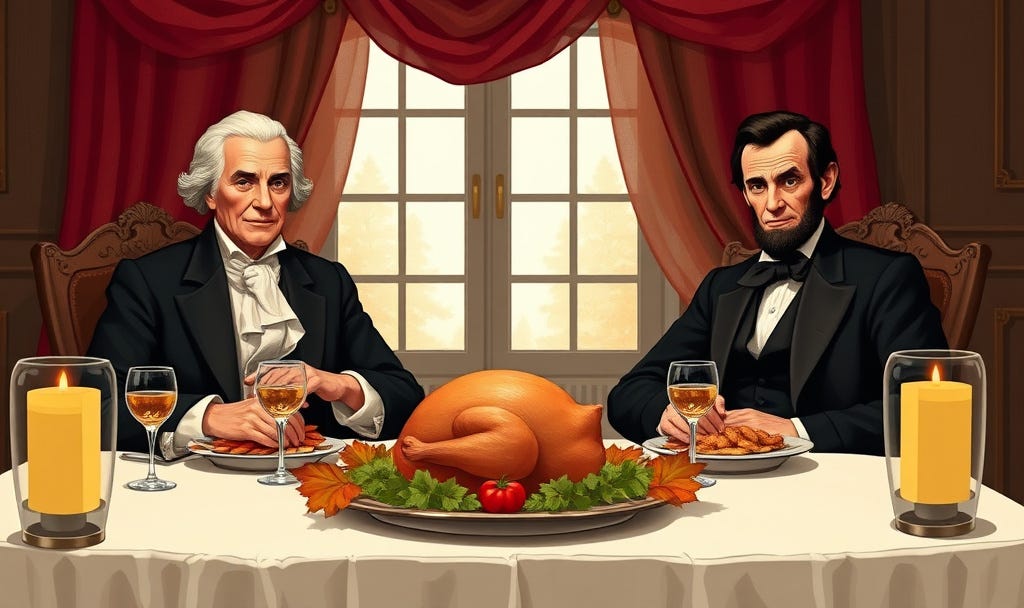
Most of us are aware of the phrase “separation of church and state,” often mistakenly thought to be inscribed into the Constitution itself. The line comes from an 1802 letter from Thomas Jefferson to Baptist leaders in New England, more than a decade after the Constitution’s ratification.
I’ve known the origin of the phrase for years, but what I didn’t know was the broader context: Jefferson was responding to criticism over his refusal to issue a federal proclamation for a national day of thanks—Thanksgiving.
Presidents Washington and Adams had both enthusiastically participated. Their proclamations read like church sermons from the national pulpit, calling Americans to prayer and acknowledging divine influence in world affairs. No one questioned whether the president could call the nation to worship. In fact, as Jefferson’s correspondence showed, it was largely expected.
Jefferson’s religious views were complicated. Often accused of being an atheist by his political opponents, he was better understood as a Deist shaped by Enlightenment values. Jefferson was skeptical of the supernatural, and crafted his own version of the New Testament stripped of miracles—the “Jefferson Bible”. Christopher Hitchens once argued that had Jefferson lived to read The Origin of Species, he presumably would’ve been a full-fledged atheist.1
Regardless, Jefferson’s religious heterodoxy, as well as his political convictions, had become a flashpoint in early American politics. And while the First Amendment clearly avoided establishing a national religion, early leaders still saw national days of prayer and thanks as appropriate expressions of civic unity.
That is, until Jefferson dissented.
The constitutionality of Thanksgiving
A tradition of thanksgiving was in place since the Declaration, when Congress initiated a national day of thanks after America’s victory at the Battle of Saratoga. Washington, who had sent troops to that battle while fighting off the British in Pennsylvania, had a clear connection to the war effort. He was more religiously devout than many other Founders and valued the influence of Federalism.
Reasonably, his proclamation for Thanksgiving in 1789 was drenched in revelatory overtones and mystic fanaticism meant to invoke a civic force.
“It is the duty of all Nations to acknowledge the providence of Almighty God, to obey his will, to be grateful for his benefits, and humbly to implore his protection and favor…
Now therefore I do recommend and assign Thursday the 26th day of November next to be devoted by the People of these States to the service of that great and glorious Being, who is the beneficent Author of all the good that was, that is, or that will be—That we may then all unite in rendering unto him our sincere and humble thanks…”
John Adams, a Unitarian and Federalist, followed his lead.
It wasn’t until Jefferson arrived that anyone thought too much about the quasi-religious tradition.
For Jefferson, it was a kind of state-sponsored religious practice, at best, and imposition, at worst. His reasoning was stylized in the letter to Baptists when describing the “wall of separation”—Jefferson supported the Constitution but was skeptical of federal impositions.
Though his letter featured in some newspapers, it was mostly interpreted as disconnected from thanksgiving proclamations, given he didn’t mention it explicitly. Thus, he remained vulnerable to Federalist attacks that accused him of godlessness, despite his once declaring a Thanksgiving while serving as governor of Virginia.
In 1808, Jefferson explained he did not think the federal government could endorse a day of thanks and prayer without running against the First Amendment—that it was best served by states and local communities.2
Thanksgiving was gradually shifting from a tradition focused on giving thanks for divine guidance in human affairs to an ideological battle about the proper relationship between government and religion, and the limits of freedom within the framework of governmental authority.
Though Jefferson never issued a Thanksgiving proclamation as president, his close ally James Madison would. Madison’s reasoning and his proclamation’s message differed widely from Washington’s and Adams’s emphasis on divine Providence.
Madison’s regrettable decision
It should be ironic that Jefferson’s right-hand man, who largely authored the Constitution, would find himself on the opposite side of this divide in American Founding politics.
Madison’s Thanksgiving proclamations occurred in the midst of the War of 1812. It was the first declared war of the United States since its founding and, more importantly, its unionization. That made it of the utmost importance to maintain a sense of national solidarity.
When I first read Madison’s proclamation, it seemed as though Madison reluctantly delivered the proclamation in the face of Congressional pressure. As it turns out, that’s more or less what occurred.
“The Senate and House of Representatives of the United States have by a joint resolution signified their desire that a day may be recommended to be observed by the people of the United States with religious solemnity as a day of thanksgiving and of devout acknowledgments to Almighty God for His great goodness manifested in restoring to them the blessing of peace.”
Madison differed slightly from Jefferson’s interpretation in that he believed legislative resolutions were the path to issuing such a proclamation.
However, after his term was over, Madison expressed regret over the proclamations and wrote letters explaining why.
“The idea also of a union of all to form one nation under one [government] in acts of devotion to the God of all is an imposing idea. But reason and the principles of the [Christian] religion require that all the individuals composing a nation, even of the same precise creed and wishing to unite in a universal act of religion at the same time, the union ought to be effected [through] the intervention of their religious, not of their political, representatives.”
After Madison’s reluctant proclamations, no president would participate in the tradition for another half century. One reason may be that Jefferson’s ideological wing controlled the presidency for at least two decades after his term. Either way, as with the earliest proclamations issued to celebrate success in military conflict, the next one would not occur until the Union was at war with itself.
The emancipation of Thanksgiving
In 1863, the Battle of Gettysburg resulted in a significant Union victory, despite the high casualty count. With this victory in mind, echoing the remnants of Washington’s proclamation, President Lincoln issued a Thanksgiving proclamation—this time with a standardized date for the last Thursday in November.
“In the midst of a civil war of unequaled magnitude and severity, which has sometimes seemed to foreign states to invite and provoke their aggressions, peace has been preserved with all nations, order has been maintained, the laws have been respected and obeyed, and harmony has prevailed everywhere, except in the theater of military conflict…
Population has steadily increased, notwithstanding the waste that has been made in the camp, the siege, and the battlefield, and the country, rejoicing in the consciousness of augmented strength and vigor, is permitted to expect continuance of years with large increase of freedom.”
Lincoln inspired the national day of thanksgiving by appealing to all Americans around a shared sense of gratitude and optimism, even amid civil conflict. By framing it as a federal observance rather than a partisan or explicitly religious act, he helped make the holiday broadly acceptable, even to those who thought more like Jefferson.
The shifting of whom thanks is given
Since Lincoln, every president has participated in the tradition of proclaiming a day of national thanks. Some have leveraged a distinctly religious message while others have strayed to a more historical and nationalized narrative, drawing to the “first” Thanksgiving as having taken place at Plymouth colony in 1621—an Americanization of the custom.
In 1939, known as the year of two Thanksgivings, FDR had to maneuver complaints that the holiday was too close to Christmas, and that consumer shopping was delayed because of its proximity. In response, Roosevelt altered Lincoln’s initial date to move to the fourth Thursday, rather than the last.
Throughout the 50s and 60s, the Thanksgiving message would move into a historical bend, and by 1969, President Nixon would make the very first Thanksgiving proclamation that did not explicitly mention a Supreme Being or divine characters—only vaguely referencing “the Source of all good” and “His blessings on mankind.”
Nearly 200 years after the Declaration of Independence, President Ford would be the first president to not mention divinity of any kind in his Thanksgiving address. He instead drew on the pluralism of American society and its successes that stemmed from it, rather than any message of an ultimate influencer.
“Let us join in giving thanks for our cultural pluralism. Let us celebrate our diversity and the great strengths that have come from sharing our traditions, our ideas, our resources, our hopes and our dreams. Let us be grateful that for 200 years our people have been dedicated to fulfilling the democratic ideal - dedicated to securing “liberty and justice for all.”
Here in the 21st century, presidents have mostly delivered proclamations that emphasize whatever their momentary base prioritizes. Presidents Bush and Trump highlighted the religious aspect while still nodding to historical inspiration. Presidents Clinton, Obama, and Biden focused more on American values and less on the religious dimension.
Looking at proclamations from Washington through today, one can see how deeply our history—including the eras of Washington and Lincoln—is embedded, compared with the Founding period, which was more overtly religious and nationally divided, by taking a look at President Biden’s 2021 proclamation:
“The Pilgrims celebrated the first Thanksgiving to honor a successful harvest, made possible by the generosity and kindness of the Wampanoag people. On the way to Valley Forge, as General George Washington and his troops continued the fierce struggle for our Nation’s independence, they found a moment for Thanksgiving. And amid the fight to preserve our Union during the Civil War, President Abraham Lincoln established Thanksgiving as a national holiday, finding gratitude in the courage of the American people who sacrifice so much for our country.”
President Trump, in his recent pardoning of turkeys, stated that “religion is coming back to America.” Polling on church attendance and beliefs in certain theologies would dispute that notion.
But more fundamentally, religion was never truly “in” American institutions in the first place. The original proclamations for a day of thanks were mostly a nod to military successes and genuine optimism for the new nation, before evolving into a mechanism for civic engagement and cohesion.
When Jefferson wrote that there should be a “wall of separation between church and state,” he was referring to the spirit and intentions of the Constitution itself. The nation was always meant to be secular, and because of Jefferson and his stance, our most treasured traditions uphold that framework—ensuring that all people, regardless of their convictions or lack thereof, are able and encouraged to participate in giving thanks for all we’ve accomplished and for what still lies ahead.
Hitchens had this amazing quote I haven’t been able to find that went something like: “Two of my heroes, Charles Darwin and Abraham Lincoln, were born on the same day—February 12, 1809. I’ll let you guess which one I think the best emancipator.”
“I do not believe it is for the interest of religion to invite the civil magistrate to direct it’s exercises, it’s discipline, or it’s doctrines; nor of the religious societies that the general government should be invested with the power of effecting any uniformity of time or matter among them. Fasting & prayer are religious exercises. The enjoining them an act of discipline. Every religious society has a right to determine for itself the times for these exercises, & the objects proper for them, according to their own particular tenets; and this right can never be safer than in their own hands, where the constitution has deposited it.” —Thomas Jefferson to Rev. Samuel Miller, January 1808
This was a seriously impressive piece, Jordan, and even as an AP U.S. History tutor, I didn't really know any of this! I did at least know that famous phrase isn't in the Constitution. :)